



Making your own biltong: the South African original

Biltong is South Africa's answer to dried meat – and something completely different from jerky: thick strips cut with the grain, a marinade of brown vinegar and salt, a crust of roasted coriander, and then 3–5 days of patient air drying at 25–35 °C. It's not ready by the clock, but by the scales: 40–50% weight loss. The drying cabinet turns the traditional attic craft into a controlled process.
Last updated: 23 July 2026 · Author: Michael Vering, Beelonia GmbH · All prices: as of July 2026
Reading tip: The faster relative with a marinade and hours instead of days of drying: Beef jerky in the drying cabinet.
Biltong vs. jerky: The differences at a glance
| Feature | Biltong | Beef jerky |
|---|---|---|
| Cut | 2–3 cm thick, with the grain | 3–5 mm thin, across the grain |
| Seasoning | Vinegar-salt marinade, coriander crust | Marinade (soy, Worcestershire, spices) |
| Drying | 25–35 °C, 3–5 days | 60–70 °C, 4–8 hours |
| Texture | firm on the outside, core juicy to firm | evenly leathery |
| Endpoint | Scales: 40–50% loss | Bend test |
The recipe step by step
- Cutting: Cut beef rump or topside with the grain into 2–3 cm thick, long strips – the lengthwise grain creates the typical bite when sliced across.
- Marinating: Moisten the strips with brown vinegar, rub with coarse salt (30 g/kg), a little sugar, crushed roasted coriander, and pepper. Leave to marinate covered in a cool place for 12–24 hours, turning once.
- Dabbing: Rinse briefly with vinegar, pat dry – the spice crust stays on. The vinegar lowers the pH on the surface and is part of the preservation.
- Drying: Hanging on hooks or lying on grids at 25–35 °C with constant air movement – in the drying cabinet for 3–5 days.
- Scales test: At 40% loss, the core is still slightly soft ('wet' – the South African favourite); from 50%, it is fully dried and has a long shelf life. Slice thinly across the grain.
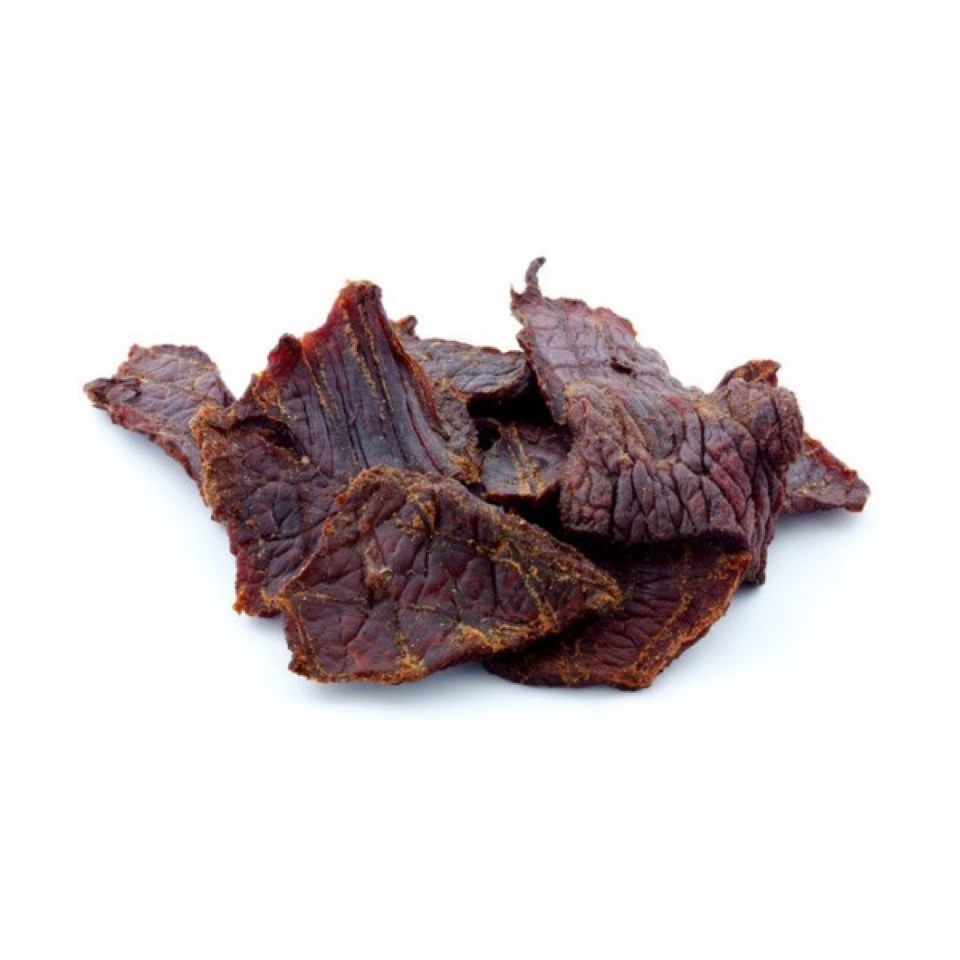
Why the drying cabinet beats the original: Traditionally, biltong hangs for days in the airy shade – in Germany, this fails due to the weather and flies. The Beelonia drying cabinet TF provides exactly the climate that biltong needs: constant low temperature, steady air movement over up to 25 tiers, and from the TF4 upwards, program control for multi-day profiles. This ensures even 5 kg batches dry evenly without a single piece spoiling.
Safety when drying raw meat: Biltong remains raw – vinegar, salt, and water extraction are the hurdles. Therefore: perfectly fresh meat, clean tools, consistent marinating, and when in doubt, work drier rather than juicier. If you want to play it safe, dry to at least 50% loss.
Frequently asked questions about biltong
Which vinegar goes into biltong?
Traditionally brown malt vinegar; apple cider vinegar is the milder alternative. The vinegar is part of the preservation and the typical taste – leaving it out is not an option.
Can I dry biltong in a smoker?
In principle, yes – a tall, well-ventilated smoker with an open draught works; the drying cabinet is more comfortable and even. Important in both cases: no heating phase, only mild warmth and air movement.
How do I store finished biltong?
'Wet' dried biltong should be stored in a cool place and eaten within one to two weeks; fully dried biltong lasts significantly longer when stored in an airy place. Only pack airtight if it is really fully dried – residual moisture will go mouldy in the container.
Reading tip: The scales principle comes from ham maturation – read about it in the raw ham guide; what else the drying cabinet can do is shown in dehydrating in the drying cabinet.
Drying like at the Cape – just more controlled
Beelonia drying cabinets provide the constant climate for biltong, jerky, and dehydrated goods – with program control from the TF4 upwards. From Beelen since 1880.
Sources and technical basis: Traditional biltong recipe (vinegar-salt marinade, coriander, air drying, wet/dry grades) from international smoking and dehydrating practice; weight loss principle analogous to the meat dossier. Beelonia product data TF series, as of July 2026. Hero photo: Delia du Plessis via Wikimedia Commons, CC BY-SA 3.0.


