



Smoking plant new or used? The TCO comparison

With commercial plants, it is not the purchase price that decides, but the Total Cost of Ownership: acquisition plus ten years of parts, energy, failures and retrofits. The rule of thumb: a used brand plant with secured parts supply can pay off excellently – a cheap exotic plant without support becomes the most expensive option in comparison with the first production failure.
Last updated: 23 July 2026 · Author: Michael Vering, Beelonia GmbH · All prices: as of July 2026
Reading tip: The private variant of this consideration – with a 7-point checklist – can be found in Used smoker; here the business calculates.
The TCO items over 10 years
| Item | New plant (e.g. F6-100) | Used brand plant | Used exotic |
|---|---|---|---|
| Acquisition | full (from 16,707.60 €) | 40–60 % of the new price | cheap |
| Spare parts/maintenance | plannable, ex works | plannable, ex works | matter of luck to impossible |
| Energy | double-walled, efficient | good (same design) | often single-walled old design |
| Failure risk | minimal + statutory warranty | moderate | high – production loss per day of failure |
| Hygiene/docu retrofit | integrated ex works | retrofit control if necessary | often not testable |
| Residual value after 10 yrs. | high | stable | scrap value |
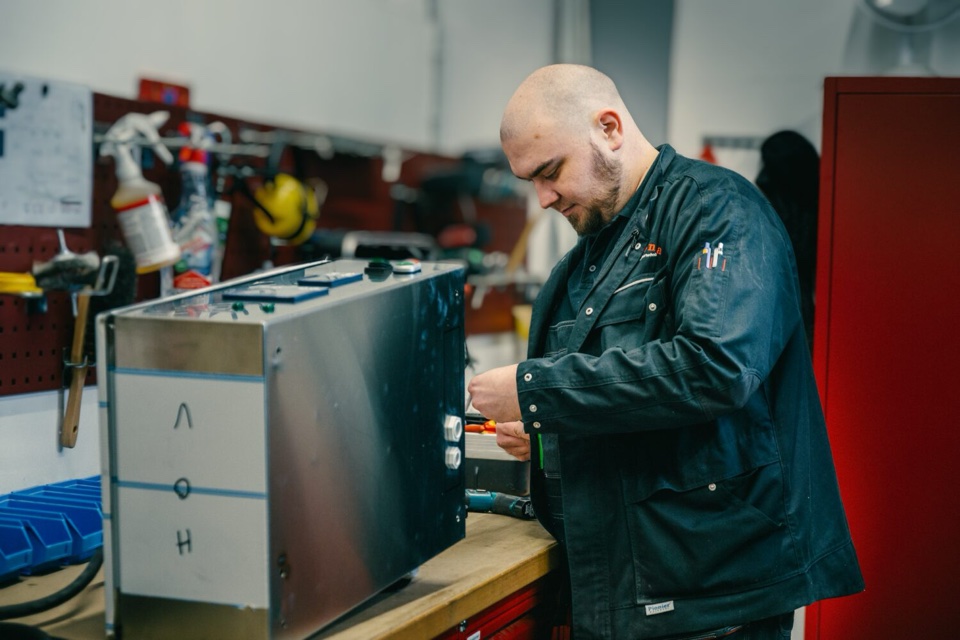
The three test questions before every used purchase: Firstly, parts supply – does the manufacturer still deliver? (With Beelonia: yes, across all years of construction; a photo of the type plate sent to service clarifies this in advance.) Secondly, hygiene capability – does the plant pass the veterinary inspection, are surfaces and documentation testable? Thirdly, the failure buffer: what does a production day of downtime cost – and how quickly is a replacement there in an emergency? Whoever answers these questions cleanly has the TCO calculation almost finished.
The energy item is underestimated: Double-walled, insulated plants maintain temperature with significantly less energy input – over ten years of production operation, this adds up to an amount that eats up entire acquisition differences between an old single-wall plant and modern insulation.
Frequently asked questions about plant TCO
How old can a used plant be?
Age counts for less than the parts situation: a 20-year-old Beelonia with deliverable modules beats a 5-year-old exotic without support. V2A stainless steel (AISI 304) practically does not age – the technology modules are replaceable.
Can I retrofit a used plant to be HACCP-capable?
With brand plants, often yes – program control and core probe can be retrofitted (1,938.51 €). The framework is in the HACCP guide.
Buy new and sell old – does the calculation work out?
With value-stable brands, yes: the sale of the old plant finances a part of the new one – a cycle that only works with parts supply. The investment side is calculated in Financing a smoking plant.
Reading tip: Why parts supply is a design principle at Beelonia is explained in Spare parts for decades.
Let's calculate together
New plant with offer or used check via type plate photo – Beelonia GmbH provides the TCO basis. Since 1880.
Sources and technical basis: TCO systematics of investment calculation; Beelonia parts supply and price data (as of July 2026); energy argument from double-wall design (device dossier).


