



Smoking trout: Guide with brine, time & temperature

Smoking trout is easy in five steps: place gutted fish in a 6–8% brine for 8–12 hours (60–80 g of salt per litre of water), rinse and dry until the skin feels leathery, then cook in the smoker at 100–110 °C for 10–30 minutes, and finally smoke at 60–90 °C until golden yellow. The trout is cooked once it reaches a core temperature of 60 °C – or when the dorsal fin can be pulled out effortlessly.
In this guide, we – Beelonia GmbH has been building smokers in Beelen since 1880 – show you every step in detail: with a brine table, temperature ranges, the four cooking tests, a video, and the five most common mistakes along with their solutions.
Last updated: 23 July 2026 · Author: Michael Vering, Beelonia GmbH · Reading time: approx. 9 minutes
At a glance: times and temperatures
| Step | Value | Duration |
|---|---|---|
| Brine | 6–8% = 60–80 g salt per litre of water | 8–12 hours, cool |
| Brine quantity | 1.5–2 litres per kg of fish | – |
| Drying | until the skin is leathery and dry | 30–60 minutes, longer depending on the weather |
| Cooking phase | 100–110 °C smoker temperature | 10–30 minutes |
| Smoking phase | 60–90 °C, beech smoking dust | 45–120 minutes until golden yellow |
| Core temperature | 60–65 °C at the spine | Measure instead of timing |
| Shelf life | chilled at max. 3–4 °C | approx. 6–8 days |
What do I need to smoke trout?
For four portion-sized trout, a smoker with a lid or door, smoking hooks, a thermometer, salt, and beech smoking dust are sufficient. If you smoke regularly, you will benefit from a smoker with separate ember and cooking zones, as this allows you to control the cooking and smoking phases cleanly.
- Smoker: for beginners, a compact smoker like the Smoky 4 smoker (approx. 10 fish, from 540 €) is enough; if you are smoking for family and neighbours, go for the double-walled Beelonia F2 (30–35 fish).
- Smoking hooks: double hooks for portion-sized trout up to 400 g, 5-prong hooks from 500 g – both V2A stainless steel (AISI 304). S-hooks from the butcher are unsuitable for fish: they only hold in the lower jaw, which tears off during cooking.
- Thermometer: without measuring, it becomes a guessing game – the Beelonia thermometer for the Smoky and F series displays 0–120 °C directly on the door.
- Smoking dust: beech is the standard for fish – for example, RÄUCHERGOLD Buche HB 500-1000. More on this in the wood section below.
- Salt: coarse evaporated salt without anti-caking agents. Nitrite curing salt is not necessary when hot smoking trout.
Reading tip: If you are starting completely from scratch, you will find the reliable 7-step process in the smoking for beginners guide, the eel guide applies the technique to the fattiest smoked fish – and the smoking temperature table provides the values for all other types of fish.
Step 1: Preparing the trout
Gut the trout, completely remove the gills and the dark kidney line along the spine, and rinse the belly cavity thoroughly under cold water. Blood residue and gills are one of the main causes of a bitter aftertaste. Only use perfectly fresh fish or fish that has been cleanly thawed in the fridge – tired fish will not make good smoked fish.
Step 2: The brine – how much salt per litre?
The practical standard for trout is a 6% brine: 60 g of salt per litre of water, steeping time 8–12 hours. Experienced smokers deliberately go higher for salmonids – in Beelonia's practice, an 8% brine has proven successful because the slightly higher salt content improves flavour and firmness. Allow 1.5–2 litres of brine per kilogram of fish; the fish must be completely covered and kept cool.
| Brine | Salt per litre | For 4 litres | When to choose? |
|---|---|---|---|
| 6% | 60 g | 240 g | Standard, mild flavour |
| 7% | 70 g | 280 g | Shorter steeping time desired |
| 8% | 80 g | 320 g | Beelonia practice: stronger, firmer |
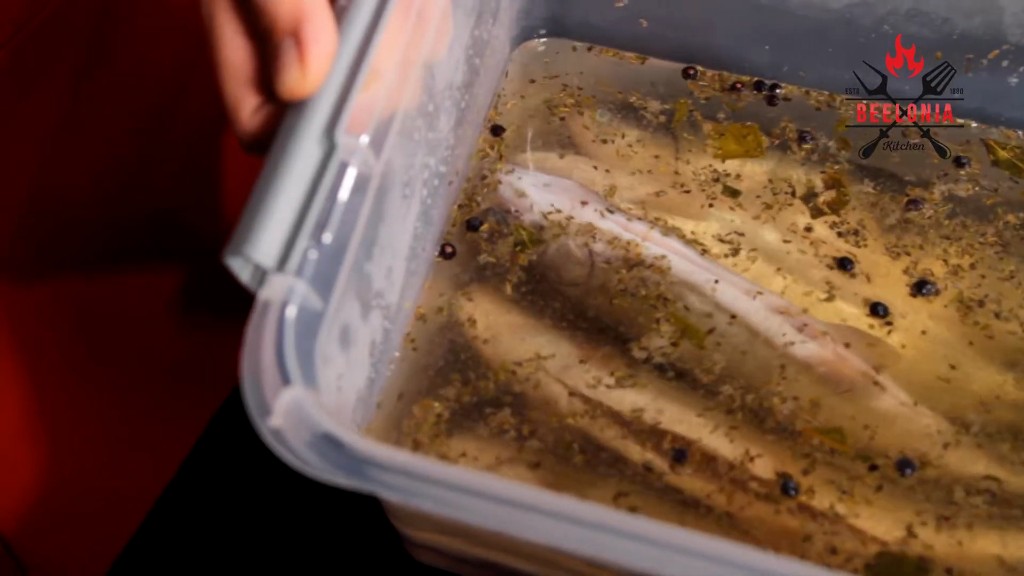
If you like, briefly boil spices such as bay leaves, juniper berries, and peppercorns in a portion of the water, let the broth cool down, and mix it with the remaining cold water – this helps the flavours dissolve better. Onions and garlic do not belong in the brine: their acidity can make the meat mushy.
Step 3: Rinsing and drying – the most underestimated step
After the brine, the trout are briefly rinsed, patted dry, and hung up until the skin feels leathery and dry – 30–60 minutes depending on the weather, significantly longer on damp days. During drying, the so-called pellicle forms, a shiny protein film to which the smoke adheres. Without it, the fish remains pale, tastes flat, and is more likely to fall off the hook.

Practical tips for hanging:
- Guide the hook through the mouth and twist it around the spine – this way the fish cannot fall off.
- Spread the belly flaps open with toothpicks so that smoke and heat can reach the inside.
- Keep your distance: the fish must not touch each other, otherwise light pressure marks will remain and the colouring will be uneven.
- In the Beelonia smoker, drying can be done directly: bring the smoker to 40–60 °C, open the exhaust fully, leave the door slightly ajar, 30–40 minutes.
Step 4: Cooking phase – 100 to 110 °C
The smoker is first heated to 100–110 °C; in this phase, the trout cooks in 10–30 minutes, depending on its size. The high initial temperature coagulates the protein and kills germs – the scientific anchor is a core temperature of 60–65 °C. Afterwards, the temperature is lowered for the smoking phase. In strong winds, a single-walled smoker has a harder time maintaining the temperature – one of the reasons why we build the F series double-walled.
Step 5: Smoking phase – golden yellow at 60 to 90 °C
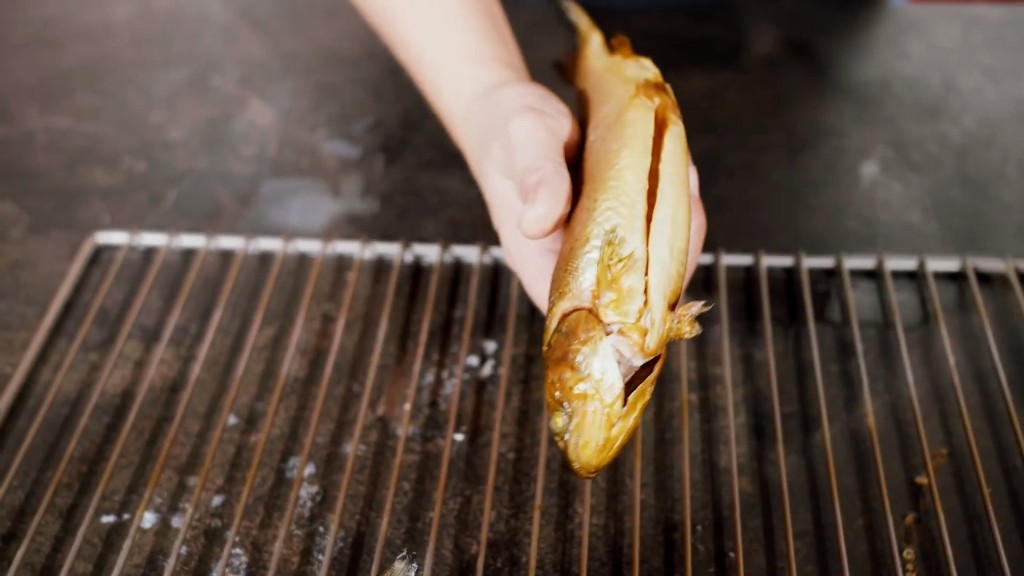
For colour and aroma, the temperature is lowered to 60–90 °C and beech smoking dust is added to the embers or the dust tray; after 45–120 minutes, the skin is golden yellow to bronze. Check the smoking dust about every 20 minutes and add more if needed. The denser the smoke in this phase, the more intense the colour – however, the smoke should remain thin and aromatic, not billow out in a biting white cloud.
Video: Smoking trout explained in 12 minutes
If you prefer to see the process in action: on our YouTube channel, Michael Vering shows the complete journey from the brine to the golden yellow trout in "Smoked trout – easily smoke it yourself" (12:40 min.) – using our smokers as an example, with all the steps for hanging and temperature control.
How do I know when the trout is cooked?
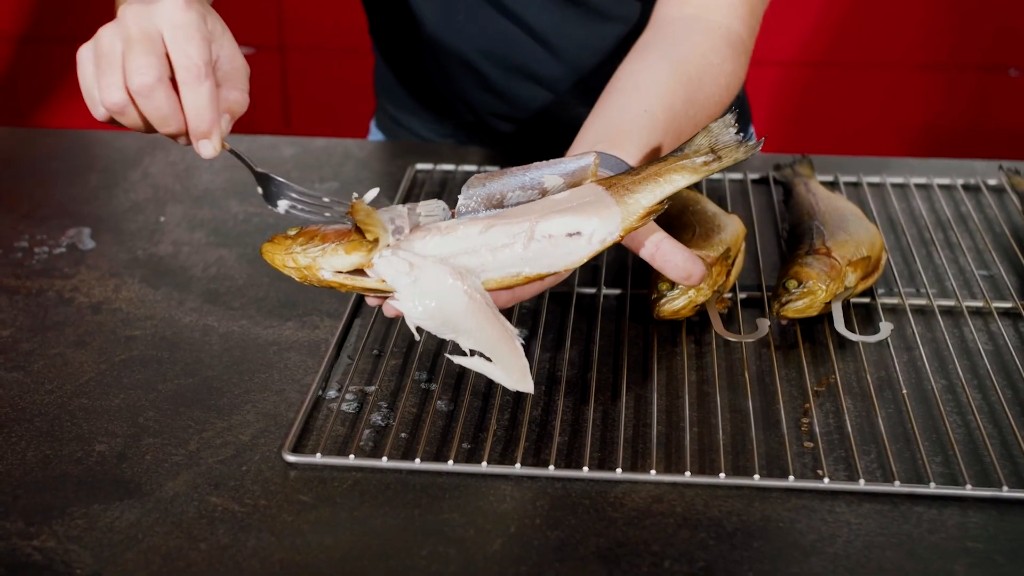
Four tests show the cooking point more reliably than any time indication: dorsal fin test, eyes, belly flaps, and core temperature. Every smoker reacts differently to weather, wind, and firing – therefore, measure and check instead of smoking blindly by the clock.
| Test | Sign of being cooked |
|---|---|
| Dorsal fin | can be pulled out effortlessly with a slight twist, meat underneath is white instead of translucent |
| Eyes | white and cloudy |
| Belly flaps | open evenly |
| Core temperature | 60–65 °C, measured at the thickest part next to the spine |
Which smoking dust for trout?
Beech is the standard wood for smoked fish: mildly spicy, reliably golden yellow colour. Alder smokes even more mildly with a reddish hue, cherry brings a fruity note and darker colour. A few crushed juniper berries in the final minutes refine the aroma. Resinous softwoods and bark are taboo – they produce soot and bitterness.
- RÄUCHERGOLD Buche HB 500-1000, 15 kg – the classic for trout & co.
- Wood chips alder, 3 kg – mild and slightly reddish
- RÄUCHERGOLD Kirsche, 10 l – fruity, beautiful dark colour
- Smoking dust "Wachholderglück" – beech with juniper, ready mixed
Which smoker fits how many trout?
The smoker size depends on the batch quantity: for 8–10 trout, a compact entry-level smoker is sufficient; fishing clubs and festivals need 100 fish and more per run. We manufacture all the models mentioned in Beelen from stainless steel – with interchangeable heating (wood, gas, or electric) and decades of spare parts supply.
| Need | Model | Capacity | Price (as of 07/2026) |
|---|---|---|---|
| Beginners, family | Smoky 4 | approx. 10 fish, 3 levels | from 540 € |
| Anglers, larger groups | Smoky 6 | approx. 25 fish | from 707 € |
| Ambitious, double-walled | F2 | approx. 30–35 fish, 5 levels | from 1,402 € |
| Club, farm shop, festival | F2-70/60 XL | approx. 120–130 fish, 7 levels | from 2,699 € |
To be honest: if you only want to smoke two trout once or twice a year, you don't need a smoker from our production – a simple table smoker or a kettle grill will do for a start. A Beelonia is worth it if you smoke regularly, want the temperature to remain reliable, and expect the device to last for decades.
The 5 most common mistakes – and their solutions
| Problem | Cause | Solution |
|---|---|---|
| Fish falls off the hook | hung too wet, overcooked, or wrong hook | dry longer, twist hook around the spine, do not exceed temperature |
| Too salty | brine too strong or steeped for too long | stick to 6–8%, observe times, salt frozen fish slightly less |
| Bitter taste | condensation, gills not removed, wrong wood, smoke too dense | heat smoker dry beforehand, remove gills, only resin-free hardwood, keep smoke thin |
| Pale instead of golden yellow | no pellicle, too little smoke | dry more thoroughly, extend smoking phase, add more smoking dust |
| Dry and rubbery | smoked too hot or for too long | measure core temperature (60–65 °C), stick to temperature ranges |
Stubborn tar and condensation residues in the smoker are best tackled with regular cleaning – for this, there is the Beelonia professional cleaner.
Safety and shelf life
Hot-smoked trout can be kept for about 6–8 days when chilled at a maximum of 3–4 °C; the heat of over 60 °C core temperature safely kills parasites such as nematodes. This is why hot-smoked fish is also considered the safer choice for pregnant women compared to cold-smoked fish. Hygiene after smoking is important: clean hands and boards when filleting, chill quickly, maintain the cold chain. If you vacuum-pack and store for longer, you must work more strictly (higher core temperature, sufficient salt content) – for home use, the rule is: enjoying it fresh is best.

Frequently asked questions (FAQ)
How long does a trout need to stay in the brine?
8 to 12 hours in a 6–8% brine, i.e. 60–80 g of salt per litre of water. The fish must be completely covered and kept cool. Shorter times work with a stronger brine, but require experience – for beginners, overnight at 6% is the safest option.
Can I smoke frozen trout?
Yes. Thaw in the fridge, maintain the cold chain, and make the brine one percentage point weaker, because thawed fish absorbs salt faster. The quality of the result depends on the initial product, not on the freezing itself.
At what temperature do you smoke trout in an electric smoker?
The values are identical to wood and gas: first 100–110 °C for cooking, then 60–90 °C for colour and smoke. Electric heating keeps the temperature particularly constant – with a thermostat, even without constant supervision. With Beelonia smokers of the F series, the heating can be switched retrospectively between wood, gas, and electric.
Why did my smoked trout turn bitter?
The four classics: gills not removed, condensation in the smoker, resinous wood, or too dense white smoke. Freshly smoked bitter substances on the surface partially dissipate if the fish rests covered in the fridge for a day.
How many trout fit in a smoker?
As a guideline: Smoky 4 approx. 10 fish, Smoky 6 approx. 25, F2 approx. 30–35, F2-70/60 XL approx. 120–130. The crucial thing is that the fish do not touch each other – it is better to plan for one more level than to hang them too closely.
Ready for your first homemade smoked trout? Everything you need to get started is available directly from Beelonia GmbH in Beelen: View smokers · Smoky 4 for beginners · RÄUCHERGOLD beech smoking dust · Fish hooks made of V2A stainless steel. Questions about choosing a model? We advise you personally – since 1880.
Further reading: If you want to dive deeper, you will find the collected craft knowledge of a professional smoker in the fish smoking book by Michael Wickert – also available in our shop.
Ready for your first homemade smoked trout?
Beelonia GmbH has been manufacturing smoking technology in Beelen since 1880 – and will advise you personally on the model, heating type, and accessories.
Sources and further reading: FAO/Torry Research Station (Hot Smoking of Fish), FU Berlin (Dissertation on the hot smoking of trout fillets), Oregon State University/FDA (Smoked Fish, safety parameters), LAVES Niedersachsen (Parasites in fishery products), as well as practical sources from the fishing and smoking community. All key figures have been cross-checked with at least two independent sources.


