



Cold, warm & hot smoking: The process guide

The most important difference between cold smoking and hot smoking is the cooking: cold smoke usually works at 15–25 °C for classic quality; the food remains raw and requires a controlled curing, drying and maturing process. Hot smoke usually works at 60–120 °C in DACH practice and cooks the food. Warm smoke at around 25–50 °C is the demanding intermediate range.
If you choose the method solely based on the desired flavour, you miss the crucial point: temperature changes not only the taste, but also protein, fat, water activity and microbial risk. That is why we clearly separate the professional corridors, the Beelonia practice from our videos and the appropriate smoke generation here.
Last updated: 23 July 2026 · Author: Michael Vering, Beelonia GmbH · Reading time: approx. 12 minutes
Which values apply at a glance?
The methods have overlapping margins, but different process goals. The following table is therefore a guide and not a universal recipe. Product thickness, curing, initial hygiene, humidity, chamber load and device design all play a role. With hot smoking, the core temperature of the product must also be measured.
| Feature | Cold smoking | Warm smoking | Hot smoking |
|---|---|---|---|
| Typical chamber corridor | 15–25 °C | 25–50 °C, often 30–50 °C | 60–120 °C in DACH practice |
| Technical margin | Beelonia video: max. 30 °C | Limits vary by source | US 'hot smoking' often 107–135 °C |
| Does the product cook? | No, it remains raw | Depending on the product, barely to partially | Yes |
| Typical duration | several rounds of 8–12 h; days to weeks | usually 1–4 h, sometimes longer | often 30 min to 3 h |
| Typical products | Raw ham, bacon, salami, smoked salmon, hard cheese | Kassler, certain sausages, soft cheese – only in a validated process | Trout, mackerel, hot-smoked salmon (Stremellachs), scalded sausage, poultry |
| Process focus | Curing, drying, smoking rounds, resting, maturing | strict temperature and hygiene management | Cooking effect plus smoke and colour |
| Suitability for beginners | only after mastering curing | low | high, especially for fish |
What is the difference between cold smoking and hot smoking?
Cold smoking matures and flavours a prepared raw product, hot smoking cooks it under the influence of smoke. This is exactly what dictates time, texture and safety logic: cold smoke requires several long smoking and resting phases as well as controlled pre-treatment. Hot smoke usually achieves the result in hours; chamber and core temperatures are decisive, not just the clock.
During cold smoking, the protein does not denature completely. Ham, raw sausage or salmon retain their raw product character, but lose water and absorb smoke components. During hot smoking, the protein visibly coagulates, fish becomes flaky and meat cooks. Warm smoke lies in between; which is exactly why you cannot assume either raw or cooked safety.
Smoke alone does not preserve reliably. Shelf life is created as a hurdle system of suitable curing, salt content, drying or water activity, process hygiene, packaging and cooling. A nice smoke flavour or a dark surface does not prove microbiological safety.
Reading tip: The exact values for each food are provided by the smoking temperature table; cold smoke practice is shown in the raw ham guide and the smoked salmon weekend project; which wood shapes the flavour is explained in the smoking dust guide.
How does cold smoking work correctly from a professional perspective?
For classic quality, cold smoking aims for 15–25 °C in the chamber. The maximum 30 °C mentioned in the Beelonia smoke generator video is a technical upper limit, not a preferred target value. If you want to keep texture, colour and fat stable, you should stay within the narrower quality corridor if possible and measure at the height of the food being smoked.
- Salt or cure the goods according to a proven, product-specific method.
- Equalise and dry until the surface is dry and slightly sticky.
- Generate smoke evenly with dry smoking dust or suitable chips.
- Smoke typically for 8–12 hours, then let it rest with fresh air for at least a similar amount of time.
- Depending on the product, repeat several rounds and then mature in a controlled manner.
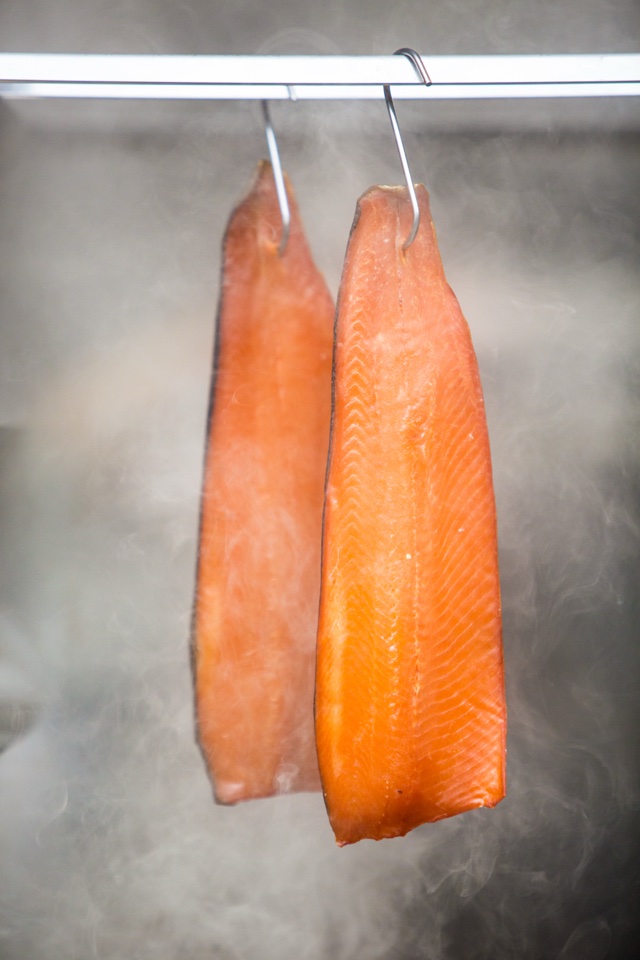
The upper limit is not the only control variable. Food that is too cold, coming straight from the fridge, can fall below the dew point: condensation binds smoke components, creates sour or bitter notes and patchy colour. Chambers that are too warm cause fat to sweat and can unintentionally start cooking the product. Exhaust air remains open; regulation is mainly done via supply air and smoke volume.
What does the F6-100 practical case show?
The video with the Reschauer family documents a commercial case study, not a general recipe. In the F6-100, about 160 kg of meat have been hanging in cold smoke for six days; 14 °C and 20 °C are visible on the display. These values show a real system load, but do not replace a curing plan or process validation.
The external smoke generator separates embers and ash from the chamber. This is practical for large batches because the smoke can be supplied continuously and the chamber should not be heated up by the embers. Duration and load must not be transferred to small hams, fish or cheese.
Why is warm smoking not a convenient middle ground?
Warm smoking usually works at 25–50 °C and remains in a microbiologically critical temperature range for a long time. Some products are slightly cooked, others remain largely raw. That is why warm smoke is not the 'gentler, safer option', but requires a proven product process with curing, time control, hygiene and subsequent cooling.
The literature is more inconsistent here than with cold and hot smoke: Kassler, Bierwurst, Bierschinken and individual cheese or fish applications are mentioned as products; real scalded sausages, on the other hand, are usually hot-smoked because they have to be fully cooked. We do not recommend warm smoke as a first attempt for beginners.
Limit: If a recipe does not provide reliable information on pre-treatment, product thickness, chamber progression, core temperature or subsequent cooking and cooling, it is not a sufficient process plan. A blanket time like 'two hours at 40 °C' alone says nothing about safety.
How does hot smoking work?
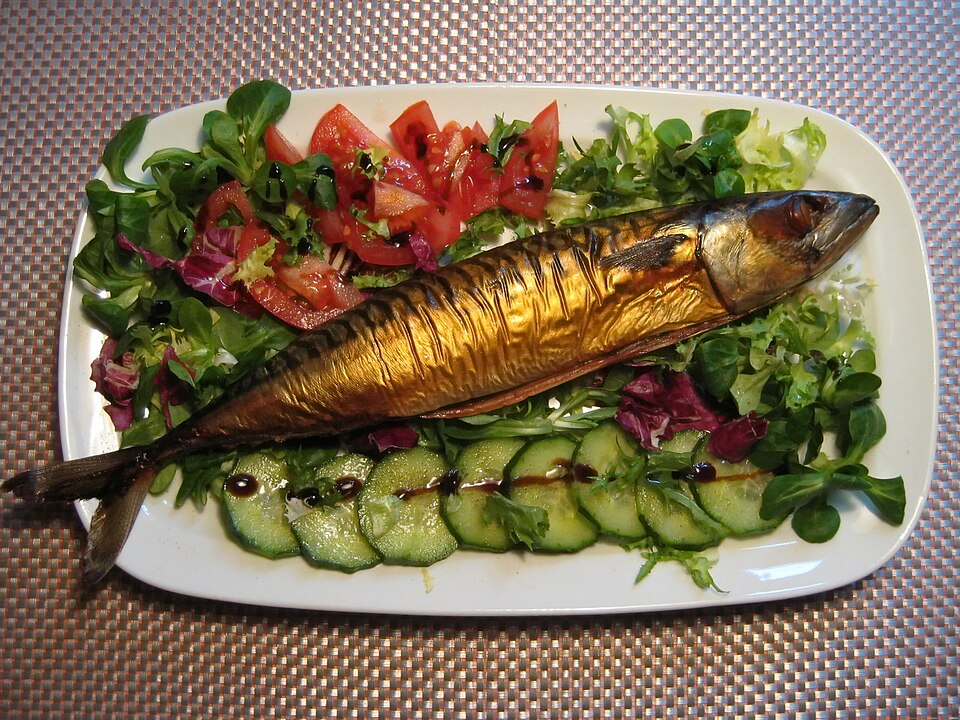
Hot smoking cooks and flavours in one step, typically at 60–120 °C chamber air. In European fish practice, many processes are between around 80 and 110 °C; in US BBQ, 'hot smoking' often refers to 107–135 °C over many hours. The decisive factor remains the appropriate core-time combination for the specific product.
| Product example | Preparation | Documented Beelonia practice | Classification |
|---|---|---|---|
| Trout | 8% brine: 560 g salt to 7 l, 12 h cool; then dry for 1–2 h | 85 °C chamber, 1.5 h; fine cherry dust; ignition approx. 15 min | complete video process, nevertheless check size and cooking status |
| Hot-smoked salmon (Stremellachs) | 7% brine: 140 g to 2 l, 12 h cool; dry for 1–2 h | 85 °C chamber, 1.5 h; ignition 10–15 min | product-specific practice, do not transfer to whole sides of salmon |
| Trout program F4/F5 | prepared trout | 40 °C/30 min drying; 85 °C/45 min cook/smoke; 60 °C/30 min gentle smoke | saved device program, not a general safety law |
The examples show why 'hot smoking = always 90 °C' would be wrong. A small fish, a whole bird, a scalded sausage and a large pork roast react completely differently. The chamber display also only describes the air at the sensor. Whether the centre is cooked is only shown by a correctly placed core probe or a validated commercial program.
How do 30 °C cold smoke and 15–25 °C fit together?
Both figures describe different levels: 15–25 °C is the preferred quality corridor of classic cold smoking practice; 30 °C is the technical upper limit mentioned in the Beelonia video. The closer you get to this limit, the smaller the reserve against protein leakage, fat loss, outside temperature peaks and measurement deviations.
In practice, this means: do not set the target range to 30 °C, but keep it below 25 °C if possible. A second probe at product height reveals stratification in the cabinet. In warm weather, smoke at night, physically separate the smoke source or postpone the round. Raw goods remain raw even with clean smoke; safety must never be deduced from the smoke colour.
Which smoke generator is suitable for which method?
For cold smoke, smoke must be produced without relevant additional heat; hot smoke, on the other hand, needs an adjustable heat source plus smoke. A cold smoke generator works with fine, dry dust. Shaft smoke generators require coarser chips so that air pockets are maintained. Electric, gas or wood provide the cooking heat; smoke and heat must be considered separately.
| Task | Suitable solution | Beelonia example | Price, as of 07/2026 |
|---|---|---|---|
| Cold smoke in Smoky/F1–F2 | external, insulated smoke generator | Smoke generator | from 497,42 € |
| Cold smoke in F4–F6-100 | external professional smoke generator | Smoke generator F4–F6-100 | from 1.001,98 € |
| Check chamber | Thermometer at product height | Thermometer for Smoky and F-series | from 38,08 € |
| Maintain electric temperature | Thermostat for F1/F2 | Thermostat F1/F2 Electric | from 249,90 € |
| Multi-stage processes | programmable control | PC program control | from 1.938,51 € |
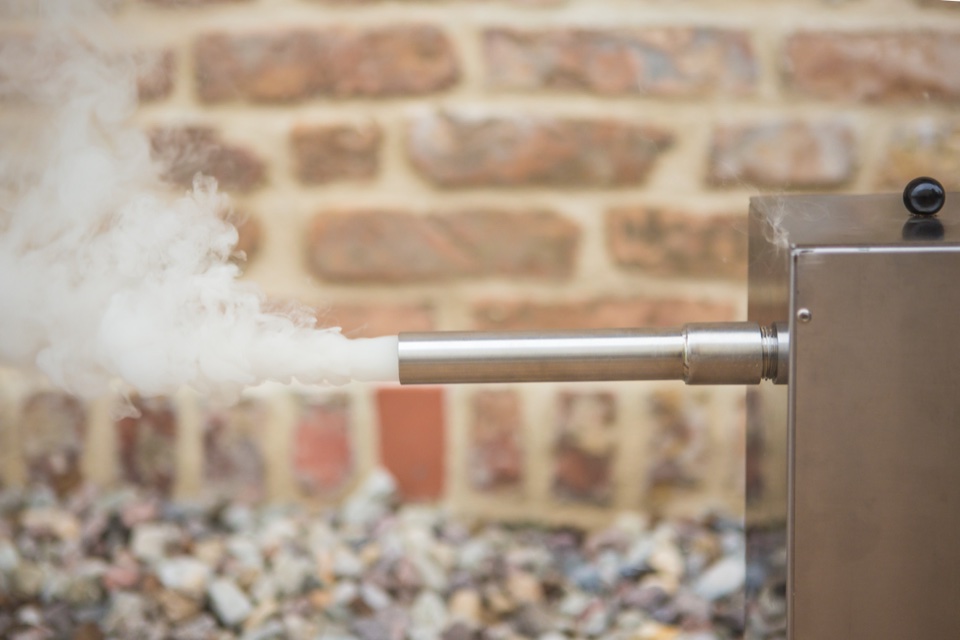
The Beelonia smoke generator is filled about three-quarters full with coarse material and lit at the bottom with a storm lighter or burner. The double-walled construction, insulated with rock wool, is designed to limit condensation and clumping in the shaft. This grain size rule applies to the shaft generator – not to a cold smoke generator.
Which smoker suits your own quantity?
Smoker size and method must fit together. A compact smoker is sufficient for occasional small hot smoke batches; frequent, weather-independent or multi-stage processes benefit from a double wall, thermostat and greater distance. Commercial devices only make sense if batch size, workflow and reproducibility justify the effort.
| Use | Model | Orientation |
|---|---|---|
| Family, entry level | Smoky 4 | approx. 10 fish, from 540,26 € |
| ambitious hobby | F2 | approx. 30–35 fish, from 1.401,82 € |
| Club, farm shop | F2-70/60 XL | approx. 120–130 fish, from 2.698,92 € |
| Commercial | F4 | Professional batches, from 7.457,73 € |
When is which method suitable – and when not?
Hot smoke is the sensible entry point, cold smoke follows after safe curing practice, warm smoke belongs in a defined process. If you only want to add a smoke flavour to already cooked food, you often do not need a multi-day smoking plan. If you want to make raw ham, on the other hand, you need much more than a smoker and smoke.
| Goal | Good choice | Not suitable if... |
|---|---|---|
| serving trout or hot-smoked salmon promptly | Hot smoking | no core measurement and no controlled cooking process are possible |
| maturing raw ham, bacon, raw sausage | Cold smoking | curing, equalising, climate and maturing are not mastered |
| flavouring hard cheese | short cold smoke in a cool climate | the cheese is already sweating or the chamber rises above 20–25 °C |
| treating Kassler/sausage warmly | only validated warm smoking process | only temperature and time from a random recipe are known |
| two fish twice a year | small hot smoker or existing grill | a large professional system would be bought just for maximum capacity |
Which mistakes ruin the taste or process?
Moisture, lack of air and incorrect temperature cause most failures. Dry surfaces, free exhaust and separate measurement of chamber and core prevent more problems than dense smoke. The smoke should pass by evenly; stagnant white smoke is not a sign of quality.
| Mistake | Consequence | Correction |
|---|---|---|
| Cold smoke permanently near or above 30 °C | Protein leakage, fat loss, texture flaws | Quality target 15–25 °C, use a second probe |
| Hanging goods damp or ice-cold | Condensation, sour spots, weak colour | bring to temperature and dry the surface completely |
| Throttling exhaust air | Smoke build-up, creosote, bitterness | Exhaust air open, regulate supply air and smoke volume |
| fine dust in the shaft generator | Compaction, embers suffocate | use coarser suitable chips |
| coarse/damp dust in the cold smoke generator | Ember chain breaks | moderately compact dry dust 0.5–1.0 mm |
| Treating smoke as proof of shelf life | invisible germ risk | Define product process, cooling and storage time separately |
Which safety limits apply?
Cold smoke does not cook, warm smoke does not cook reliably, and even hot smoke is only as safe as its core-time combination. Cold-smoked fish in particular requires strict curing, cooling and packaging control; Listeria and Clostridium botulinum are not excluded by a strong smoke flavour. Risk groups should follow official recommendations.
Freshly hot-smoked goods must be kept refrigerated. The often-mentioned 'months of shelf life' refer to sufficiently cured, dried and matured raw products, not just any freshly smoked batch. In commercial operations, documented processes, a hygiene concept and, if necessary, water activity or salt analyses are part of this.
No-Fit: This guide does not replace recipe validation, HACCP assessment or official regulations. Unknown raw materials, interrupted cold chains, improvised vacuum storage and poultry without reliable core measurement are not areas for estimates. If in doubt, do not process further or serve.
Which questions are asked most frequently?
What is the most important difference between cold smoking and hot smoking?
Cold smoking typically works at 15–25 °C and leaves the prepared food raw; the process matures, dries and flavours over several rounds. Hot smoking usually works at 60–120 °C in DACH practice and cooks the food. Therefore, pre-treatment, duration, texture, measurement and safety requirements differ fundamentally.
Can cold smoke reach 30 °C?
The Beelonia video mentions 30 °C as a technical upper limit. For classic quality, however, the professional basis usually recommends 15–25 °C. Plan with the narrower corridor so that there is a reserve for outside temperature, ember heat and measurement deviation. 30 °C is not a target value; raw goods are not safely cooked by this.
Is warm smoking safer than cold smoking?
Not across the board. Warm smoke is often at 25–50 °C and thus remains in a range where microorganisms can grow for a long time. Depending on the product, only a partial cooking effect takes place. The process only becomes safe through a validated overall process of pre-treatment, time, temperature, hygiene, cooling and, if necessary, subsequent complete cooking.
Which method is suitable for beginners?
Hot smoking, especially of fish, is the most sensible entry point: the process takes hours instead of days, the goods cook and chamber as well as core temperatures can be measured directly. After that, cheese in cool cold smoke is a good option. Cured meat and raw sausage should only follow when curing, drying and maturing climate are safely mastered.
Do I need a separate smoker for all three methods?
No. A sufficiently high smoking cabinet with an adjustable heat source, free air flow and a separate cold smoke generator can cover all three methods. A compact table smoker, on the other hand, is almost only suitable for hot smoke. The decisive factors are temperature range, distance to the embers, measurement options, insulation and the actual batch size required.
What is the conclusion for choosing a method?
The correct order is product → process goal → temperature control → smoke generation → device. Cold smoke remains raw and prefers 15–25 °C, warm smoke needs special process discipline, hot smoke cooks and requires a product-related core measurement. In this way, seemingly contradictory numbers become comprehensible corridors instead of supposedly universal recipes.
To deepen your knowledge, we recommend Das Fischräucherbuch: it covers methods, woods, devices and typical mistakes in a coherent way. We at Beelonia answer questions about the appropriate smoker or smoke generator size based on your batch and your desired method – not just based on the largest model number.
Get started cold, warm or hot?
Beelonia GmbH has been manufacturing smoking technology in Beelen since 1880 – and will advise you personally on model, heating type and accessories.
Sources and professional basis: German Food Code Commission, Leitsätze für Fisch und Fischerzeugnisse (as of October 2024); FDA, Processing Parameters Needed to Control Pathogens in Cold-Smoked Fish; BfR and BVL on Listeria in smoked fish; USDA-FSIS on the temperature 'Danger Zone'; Culinary Institute of America, The Smoking Process; Max Rubner Institute/Hitzel et al. on smouldering smoke and PAH formation; Beelonia videos 'Der Raucherzeuger', 'Familie Reschauer: Kalträuchern im F6-100', 'Räucherforelle', 'Heißgeräucherten Lachs räuchern' and 'Vorstellung Profi-Räucheröfen F4 & F5'. Professional corridors were cross-checked against several DACH practice sources; video details are marked as Beelonia practice or case study.
Suitable items from the range: Smokers from the manufacturer.


