



Core temperature when smoking: values, measuring, probes

When hot smoking, only the core temperature proves that fish, meat or poultry is cooked and safe inside – the chamber temperature and the clock are mere guides. Because thickness, fat content, starting temperature and load shift the cooking time considerably. You measure at the thickest, slowest-cooking point. The target ranges: fish ~60–65 °C, poultry at least 70–72 °C over holding time, cooked cured meat 65–70 °C – cold-smoked food has no cooking end point at all, it remains raw.
Last updated: 23 July 2026 · Author: Michael Vering, Beelonia GmbH · All prices: as of July 2026
Reading tip: Chamber and core values for each product are summarised in the smoking temperature table – this article explains the measuring itself.
Core temperature target values at a glance
| Product | Core target value | Note |
|---|---|---|
| Trout / fish hot | ~60–65 °C (FDA: 62.8 °C / 30 min) | measure at the spine |
| Eel hot | 60–65 °C | plus belly flap test |
| Salmon hot (Stremel) | 63–68 °C | juicy at ~63 °C |
| Poultry | min. 70–72 °C over holding time | whole birds practically higher |
| Kassler / cooked ham | 65–70 °C | cooked cured meat, cooked |
| Pulled pork | ~90–95 °C | high so collagen breaks down |
| Cold smoke (salmon, ham) | no cooking end point | remains raw – safety via salt/drying |
The values are professional ranges, not approved recipes: stricter requirements apply to poultry, raw sausage and vacuum-packed smoked fish – if in doubt, cook to a higher temperature.
How do I measure correctly?
The probe belongs in the thickest, slowest-cooking part – and nowhere else. For fish, next to the spine (not on the bone, otherwise you measure the bone), for poultry in the thickest part of the leg without bone contact, for roasts and ham exactly in the middle. Bones conduct heat differently, as do fat veins – an incorrectly placed probe will quickly show 5–10 °C off.
Two thermometers, two jobs: The chamber thermometer (at grate level) controls the smoker, the probe thermometer checks the food. If you separate the two, you understand your smoker: if the chamber is at 85 °C and the core is only creeping up slowly, it's due to the load or starting cold – not the smoker.
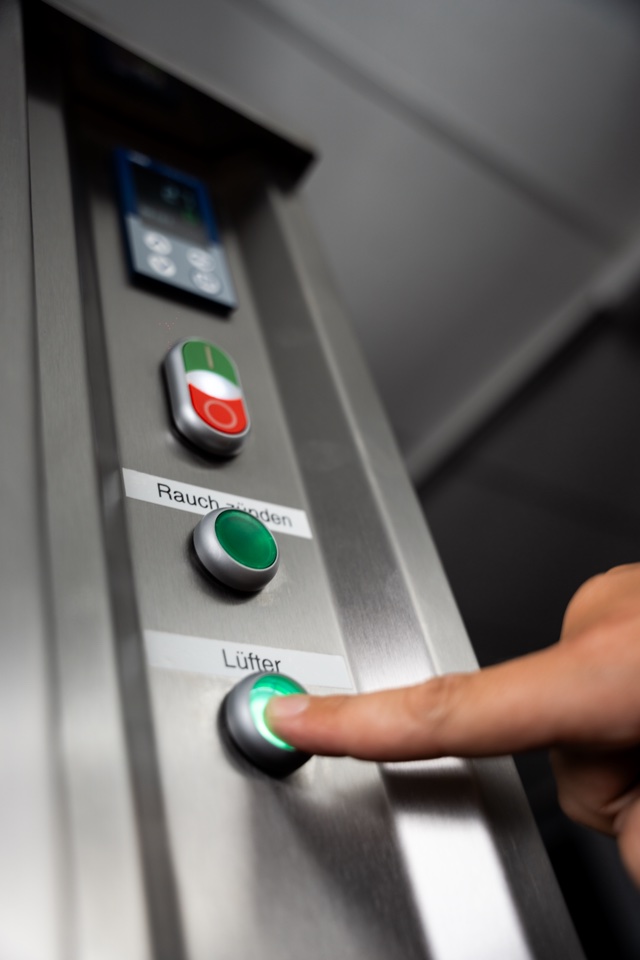
Comfort level automatic probe: The PC program control of the professional devices works with a permanently installed core temperature probe and runs programs up to the target value – in the hobby sector, a separate probe thermometer takes over this task. With pulled pork, for example, the smoker runs for 16 hours until the probe reports 92–95 °C.
The four most common measuring mistakes
- Probe on the bone: shows too high – always into the meat, not against the bone.
- Trusted too early: a single reading fluctuates; wait briefly until it is stable.
- Only measured once: with several pieces, check the thickest one, not the first one you see.
- Confused chamber with core: 85 °C air does not mean 85 °C in the fish – that is the most expensive error in reasoning.
Frequently asked questions about core temperature
Do I need an expensive core temperature measuring device?
No – a solid probe thermometer is sufficient for a hobby. More important than the price is the correct position and a device that quickly shows a stable value. For long runs, a model with a cable probe and alarm is worthwhile.
Does the core temperature also apply to cold smoking?
No: cold-smoked food remains raw, there is no cooking end point. Safety is achieved there via salt, drying and cooling – details in the smoked salmon guide.
Why does the core temperature sometimes hardly rise for hours?
With large pieces of meat, this is the "plateau phase": evaporative cooling on the surface slows down the rise. Persevere or – as is common with pulled pork – wrap the piece in foil, then the temperature will pick up again.
Reading tip: If the smoker does not hold the chamber temperature, the diagnosis smoker does not get hot helps; the process limits are explained in the process guide.
Measure instead of guessing
Thermometers, thermostats and program controls with core probes – Beelonia GmbH supplies the measuring technology for safe results. Since 1880.
Sources and technical basis: Core temperature ranges from the fish, meat and process dossiers (fish 60–65 °C, FDA 62.8 °C/30 min, Stremel 63–68 °C, cooked cured meat 65–70 °C, poultry ≥70–72 °C) and the smoking temperature table; measuring practice (probe position, plateau phase) from technical literature. Prices: beelonia-shop.de, as of July 2026.


