



Removing tar & condensate in the smoker

Tar in the smoker is coagulated smoke condensate – insoluble in water, sticky, bitter, and combustible from a certain layer thickness (shiny soot). It is almost impossible to tackle mechanically; the solution is chemical: an alkaline smoke resin remover dissolves the deposits, which are then wiped away. Just as important as removal is eliminating the causes – because tar only forms when thick smoke hits cool surfaces.
Last updated: 23 July 2026 · Author: Michael Vering, Beelonia GmbH · All prices: as of July 2026
Reading tip: The complete basic cleaning with intervals and the patina question can be found in the cleaning guide – here we focus specifically on the most stubborn opponent.
Where does tar sit – and why exactly there?
Tar condenses on the coolest spots with the most smoke contact: the throttle valve and exhaust pipe first, then the lid area and door rebate. It is particularly tricky on the valve because it glues the mechanics together – the slider gets stuck, the draught can no longer be regulated, and the next tar problem is inevitable. In the pipe, it grows insidiously until the draught noticeably decreases. If you keep an eye on these three areas, you will spot the problem before it ruins the result.
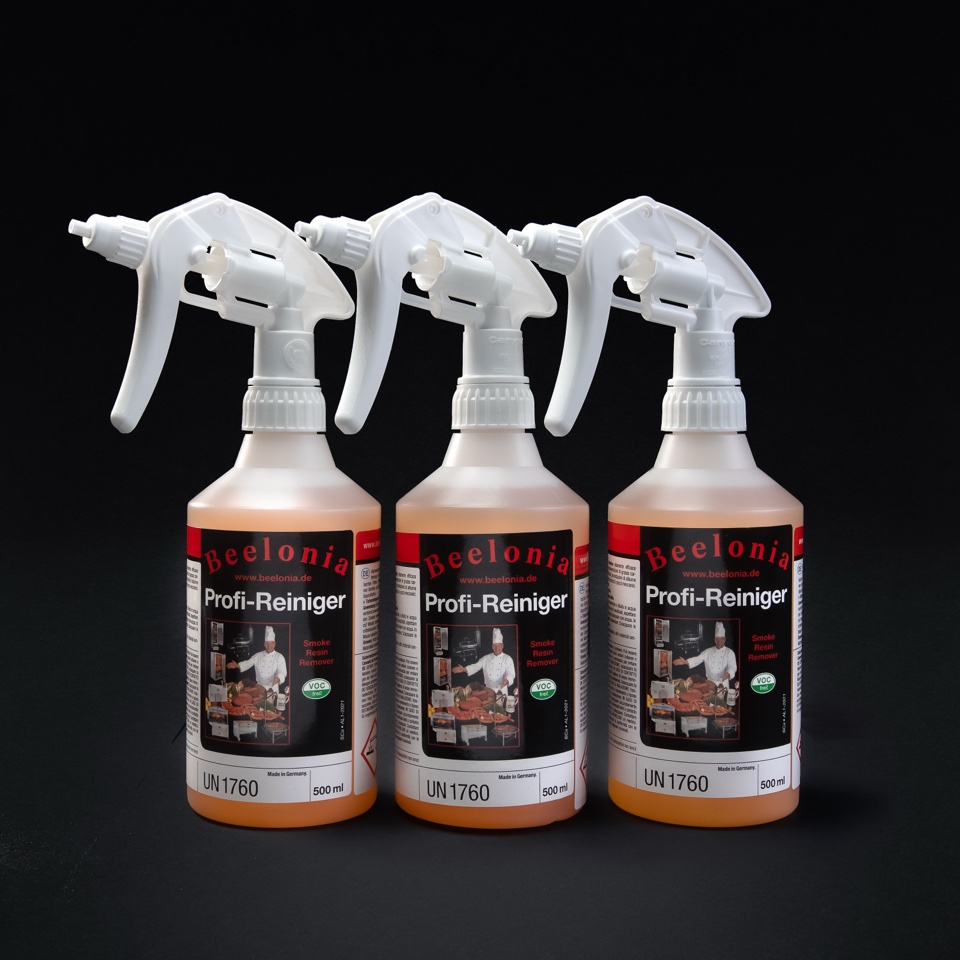
Removal in four steps: First, remove loose flakes with a wooden or plastic spatula (no wire sponge – it scratches V2A stainless steel (AISI 304)). Then spray on the professional cleaner (€20.83) and let it work: the tar emulsifies and visibly runs off dark – place cardboard underneath. Work in circles with the sponge, wipe off with an old rag, and wipe again with warm water. Finally, heat up the empty smoker at around 100 °C. Result as in the Beelonia video: bare stainless steel even under years-old deposits.
The valve cure: Stuck throttle valve? Warm up the smoker slightly – the resin softens, and the valve moves again. Then spray the mechanics, make them run smoothly, and clean them regularly in the future.
Eliminating causes: so the tar doesn't come back
Tar is always a symptom – the causes are thick smoke and cold surfaces:
- Dry dust: Damp smoking dust smokes white and tarry – store RÄUCHERGOLD dry.
- Keep the draught open: Trapped smoke condenses; adjust the air supply and exhaust correctly.
- Thin blue smoke: Less, cleaner smoke means less condensate – the basics in the article Blue smoke, white smoke.
- Warm walls: Double-walled smokers simply offer no cold surface for the condensate – one more reason for insulation.
Frequently asked questions about tar & condensate
Does the brown patina have to go too?
No – the thin, matte patina is desirable and contributes to the aroma. Only the greasy, shiny, thick tar layer (shiny soot) has to go. The distinction is explained in the cleaning guide.
Can I just burn out the tar?
No – targeted 'burning out' of thick tar layers is a fire risk and, in extreme cases, warps the sheet metal. Chemical dissolving is the safe way; only the final heating at ~100 °C is part of it.
Does tar also drip onto the smoked goods?
Yes – as dark, bitter-tasting condensate spots, especially from the lid. In the short term, cardboard or paper towels above the goods help; permanently, the list of causes above; the spot diagnosis is in the error diagnosis.
Reading tip: The basic condensate problem – why it occurs and what the double wall changes – is explored in depth in Condensation in the smoker.
Tar-free in 45 minutes
The Beelonia professional cleaner dissolves smoke resin without scrubbing – developed for our own V2A stainless steel (AISI 304) smokers from Beelen. Since 1880.
Sources and technical basis: Cleaning and error pattern dossier (dissolving tar/smoke resin mechanically or alkaline, shiny soot fire hazard, throttle valve maintenance); Beelonia cleaning video (application, result). Prices: beelonia-shop.de, as of July 2026.


