



Cleaning your smoker: instructions, intervals, agents

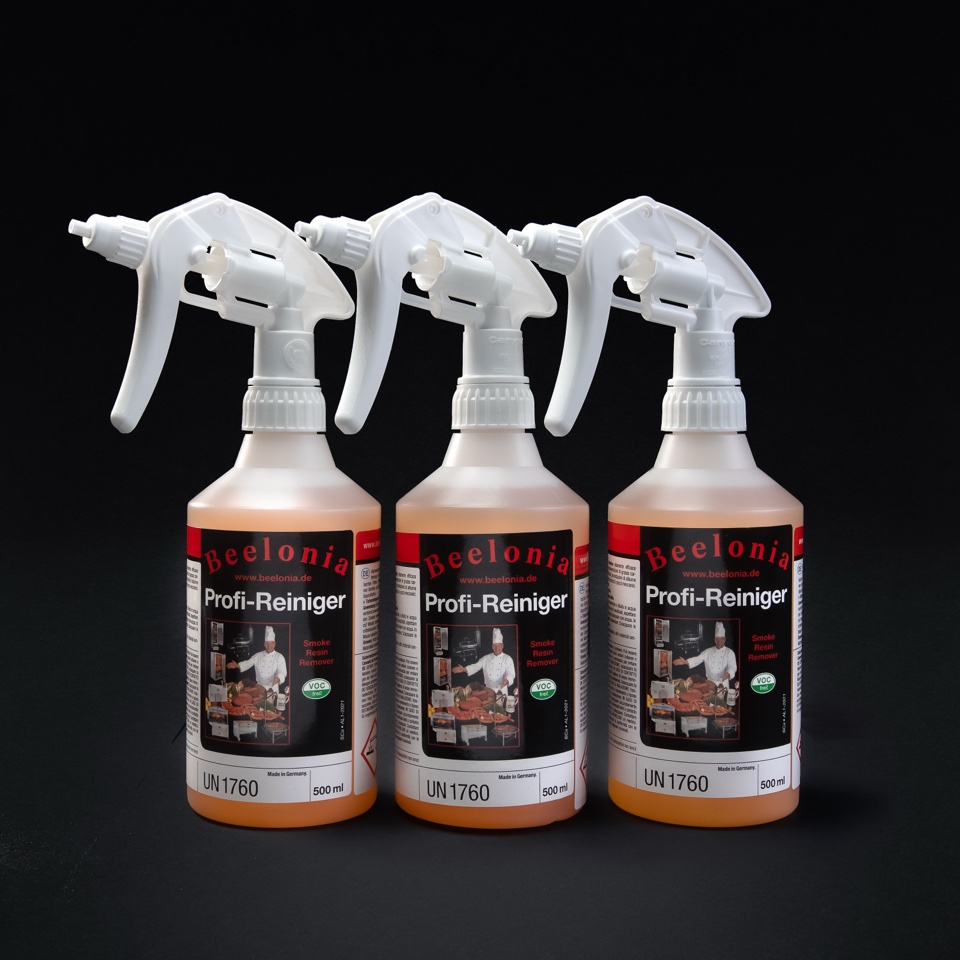
The cleaning rule for smokers: remove ash and fat after every run, deep clean at least once a year for hot smoking – 2–3 times in commercial use, as the veterinary office pays attention to this. The matte aroma patina can stay; what must go is the shiny tar coating, the so-called shiny soot – it is flammable. With an alkaline smoke resin remover like the Beelonia Profi-Reiniger (€20.83), a deep clean is done in under an hour.
Last updated: 23 July 2026 · Author: Michael Vering, Beelonia GmbH · All prices: as of July 2026
Reading tip: After every deep clean, the smoker is briefly heated up empty – essentially a mini seasoning like during the initial setup.
Clean or maintain patina: Which is right?
Both – depending on use: The thin, matte patina is desired during cold smoking and can stay; the greasy, shiny soot, on the other hand, is a tar layer that can catch fire during hot smoking at 80–120 °C. This question is passionately discussed in smoking communities – the answer simply depends on the process and use:
| Use | After every run | Deep cleaning |
|---|---|---|
| Private, mostly cold smoke | Remove ash, wipe off fat | Less often – keep patina for aroma, only remove shiny soot |
| Private, hot smoking | Remove ash, remove dripping fat | At least 1× per year (fire protection) |
| Commercial | Ash, fat, grates | 2–3× per year – veterinary office practice for stainless steel smokers |
A practical warning example: In old brick smoking chambers that haven't been cleaned for five or six years, literal tar stalactites grow from the ceiling and walls – at that point, cleaning is no longer a matter of taste, but of fire protection. And one more rule upfront: If fat or soot ever catches fire – close the door, close the air dampers, never use water.
Step by step: Deep cleaning with the Profi-Reiniger
You need four things: a piece of cardboard as a base, a bucket of warm water, a sponge and an old rag – plus the smoke resin remover. Here is how the cleaning works, as shown in the Beelonia video:
- Preparation: Place cardboard under the smoker and door area – the dissolved tar immediately runs down visibly and shouldn't end up on the patio or paving. Remove grates, rods and trays.
- Spraying: Spray the Profi-Reiniger generously onto the resinous surfaces. The effect is immediately visible: The smoke resin dissolves and runs off dark, revealing the stainless steel.
- Working in: Follow up with the sponge in circular motions, especially on corners, folds and the inside of the door.
- Removing & rinsing: Pick up dissolved dirt with the old rag (it won't get clean again – hence an old one), wipe with warm water, let dry.
- Heating up: Heat the smoker through once empty at around 100 °C. After 2–3 smoking runs, the usual colouring returns – the result tastes just like before.
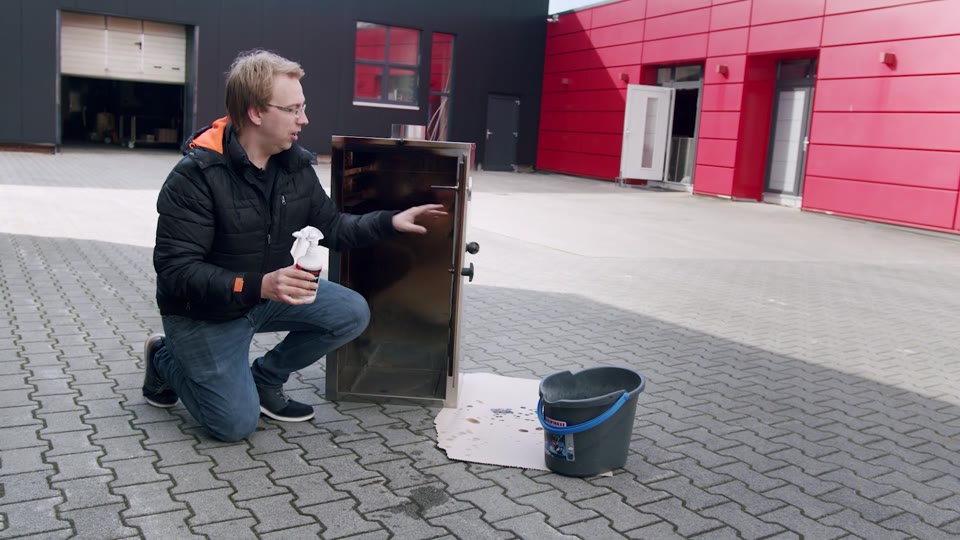
The difference is – as the video concludes – "like day and night": Even hard-baked, deeply soiled surfaces become bare metal again. The alkaline cleaner dissolves what would otherwise only be possible mechanically by scratching – and scratching is exactly what should be avoided.
Two things do not belong in the smoker: wire sponges and scouring agents. They scratch the stainless steel, and if you scrub away the entire patina, you unnecessarily lose the developed aroma profile. The goal of deep cleaning is the shiny soot, not bare surgical cleanliness after every run.
An often overlooked maintenance point: the damper at the top of the exhaust. Its sliding mechanism gets stuck with smoke resin if it is adjusted while warm and then seizes up when cold. Therefore, clean the mechanics regularly – if it is stuck, warm the smoker slightly, then it will loosen.
Grates, hooks, trays: What gets clean and how?
Accessories are the real hygiene issue – this is where fat and protein residues settle directly in contact with food: Rinse or soak grates and hooks hot after every run, spray stubborn coatings with the cleaner. Smoking dust trays and drip trays are emptied and wiped out as soon as they are cold – accumulated fat on the drip tray is the most common cause of fat fires. V2A stainless steel grates can also go in the dishwasher; dry afterwards, done.
Frequently asked questions about smoker cleaning
Do I need to re-season after cleaning?
A brief heat-up is enough: once empty to about 100 °C – this removes cleaner residues and moisture. The aroma colouring builds up again on its own over the next 2–3 smoking runs; the result is flawless from the first run.
Is washing-up liquid enough instead of smoke resin remover?
For fresh fat yes, against baked-on smoke resin no: Tar resins are insoluble in water and need an alkaline solvent. Washing-up liquid remains for accessories and follow-up cleaning – the smoke resin remover for walls, door and damper.
How do I clean the glass pane in the smoker door?
Like the walls: spray on, let it work in briefly, wipe off – never shock it cold with water when the pane is still hot. Heavily resinous panes need two passes. If the pane is cracked, replacements are available directly from the factory.
Reading tip: Whether a part is due after cleaning – seal, grate, heating element – is shown in the article Finding Beelonia spare parts; the basic care routine for beginners is in the beginner's guide.
Bare again in 20 minutes
The Beelonia Profi-Reiniger dissolves smoke resin and tar without scrubbing – developed for their own stainless steel smokers from Beelen.
Sources and technical basis: Beelonia cleaning video (shiny soot, veterinary office intervals, application demo); care and fire protection rules from equipment and smoker knowledge (patina vs. shiny soot, fat fire: close lid, no water; deep cleaning annually, commercial 2–3×). Price of Profi-Reiniger: beelonia-shop.de, as of July 2026 (in the video still €19.90 – price updated).


