



Smoking for beginners: the 7-step guide

Beginners learn smoking most safely with hot-smoked trout: an 8% brine made of 560 g salt and 7 l water, steep cool for 12 hours, rinse, dry for 1–2 hours or dry at 40 °C with circulating air, then smoke at 85 °C for a total of 1.5 hours using fine cherry smoking dust. The smoke ignition runs for approx. 15 minutes in the Beelonia electric smoker shown; the cooking test and measured core temperature are decisive, not the clock alone.
These values come exactly from the Beelonia practical video "Smoked trout – easily smoke it yourself" with Michael Vering. Alongside this, this guide shows the broader technical corridors from the knowledge base. This is important: a specific electric smoker recipe at a constant 85 °C and a general two-phase hot smoking guide are two valid process paths – they must not be mixed without comment.
Last updated: 23 July 2026 · Author: Michael Vering, Beelonia GmbH · Reading time: approx. 12 minutes
Why should beginners start with hot smoking?
Short answer: hot smoking cooks the food, is finished in hours and is more forgiving than cold or warm smoking, which takes days.
Cold smoking usually works at 15–25 °C and leaves fish or meat raw. For this, curing, water activity, maturation and the cold chain must be safely mastered. Warm smoking at around 25–50 °C stays in the hygienically critical temperature range for a long time. Hot smoking in DACH practice works roughly at 60–120 °C and cooks the product. For the first run, trout is therefore a sensible, easily observable starting point.
This does not mean that hot-smoked fish is automatically shelf-stable. It must be chilled quickly after cooling down. Smoking replaces neither clean working practices nor the cold chain.
Which practical values apply in this 7-step guide?
Short answer: for the first reproducible attempt, we follow the complete Beelonia video process; general technical values are right next to it.
| Process point | Beelonia practice in the video | Technical corridor / Classification |
|---|---|---|
| Brine | 8% = 560 g salt to 7 l water | Knowledge base mostly 6–8%, 8–12 h; the video mentions 7–10% and chooses 8% |
| Steeping time | 12 h covered in the fridge | within the usual corridor of 8–12 h |
| Rinsing | thoroughly cold, also in the abdominal cavity | removes surface salt and slime |
| Drying | 1–2 h in the fridge or approx. 40 °C with circulating air | The goal is always a dry, leathery-sticky pellicle; time depends on humidity and fish size |
| Smoker | constant 85 °C | DACH hot smoke overall approx. 60–120 °C; many guides work in two phases with a hotter cooking and milder smoking phase |
| Smoking duration | 1.5 h in total | Core temperature and cooking test take priority |
| Wood | fine cherry smoking dust, 500–1000 µm | Beech is the mild standard; cherry is a fruity hardwood variant |
| Ignition | approx. 15 min in the electric device shown | device-specific; other Beelonia controls work automatically or with a different factory value |
| Cooking test | milky-white eyes, skin peels off cleanly | additionally measure core: DACH practice around 60–65 °C |
The apparent temperature contradiction is thus resolved: the video runs a continuous, regulated 85 °C process. The knowledge base additionally describes the classic two-phase method, in which the food is first cooked at a higher temperature and then flavoured at a lower temperature. For the first attempt, stick to one complete process and do not switch between the two in the middle of the process.
Reading tip: The detailed trout guide with brine, time and temperature deepens every step; before the very first run comes the seasoning of the new smoker; values for other fish species can be found in the smoking temperature table.
What do I need to learn smoking?
Short answer: for five trout, a safely positioned hot smoker, suitable hooks, a cooking chamber/core temperature gauge, salt, water and fine hardwood smoking dust are sufficient.
Which ingredients does the Beelonia practice use?
| Ingredient | Quantity |
|---|---|
| gutted salmon trout | 5 pieces |
| cold water | 7 l |
| sea or table salt | 560 g |
| juniper berries | 8–9 pieces |
| bay leaves | 4–5 pieces, crumbled |
| garlic powder | to taste |
| Herbes de Provence | to taste |
| fine cherry smoking dust | grain size 500–1000 µm |
Spices are a matter of taste; the safely controlling variables are salt concentration, cooling, drying and temperature. If you deliberately want to start neutral, you can reduce the spices and leave the process unchanged.
What basic equipment do I need?
- Smoker: for small batches, for example Smoky 4, Smoky 5 or Smoky 6
- Hooks: Fish double hooks for portion-sized fish; 5-prong hooks for heavier fish from around 500–600 g
- Temperature control: Thermometer for Smoky and F-series, supplemented by a clean core probe
- Smoking dust: Cherry in the recipe; as a universal standard RÄUCHERGOLD Beech HB 500-1000
- In-depth reading: The Fish Smoking Book
Which safety rules apply before step 1?
Short answer: only smoke outdoors or with a professionally approved exhaust system, on a non-combustible surface, with a free flue and without leaving the smoker unattended.
- Never operate in a garage, shed or enclosed space without an approved exhaust solution.
- Keep a distance of at least approx. 2 m from combustible hedges, fences and building components; local regulations and the operating manual take precedence.
- Choose a fireproof, level surface and have a suitable extinguishing agent ready.
- In the event of a grease fire, do not use water; stop the energy supply and close the air supply according to the device manual.
- Handle raw and cooked goods with separate boards, tongs and clean hands.
- Keep fish chilled until processing and keep the brine covered in the fridge.
- Do not close the exhaust air for "more smoke": trapped white smoke creates bitter tar substances.
Step 1: How do I set up the workspace and smoker safely?
Short answer: set up the cold, clean smoker securely, check the air supply and exhaust, grease drip tray and thermometer, and have all tools ready before starting.
The smoker must be empty and technically in order. Remove old ash and loose grease deposits; a well-kept patina on the walls is different from rancid residues. Grease must not drip into the embers or heating area. Check whether the hooks, rods and drip tray match the batch. With wood or gas, the flame must be clean and controllable; with electric, the cable and connection must be dry and undamaged.
Plan the run so that you remain present during the 1.5 hours. Weather, wind and fish size may require readjustment.
Step 2: How do I prepare the 8% brine?
Short answer: dissolve exactly 560 g of salt in 7 l of cold water, optionally add the video spices and place five gutted trout completely covered in the fridge for 12 hours, covered.
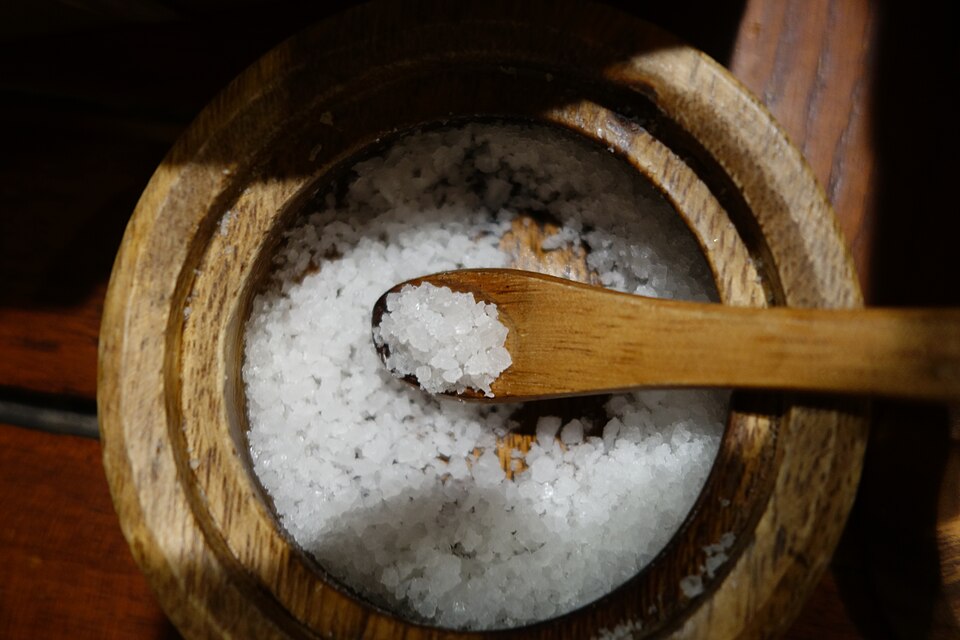
8% means 80 g of salt per litre of water. For other quantities: Litres of water × 80 g = amount of salt for 8% brine.
The brine must be cold before the fish goes in. Gills, blood residues and the dark kidney line along the spine should be removed. If necessary, weigh the fish down with a clean, food-safe insert so that they all remain evenly covered. A stronger brine does not automatically shorten the time safely and with controlled taste – for the first attempt, stick to the recipe and 12 hours.
Step 3: How do I rinse and hook the trout?
Short answer: rinse each fish thoroughly inside and out with cold water, pat dry and anchor the double hook in the bones to the left and right of the spine.
In the video, rinsing continues until no more slime can be felt on the outside. The hook is guided through the mouth; its prongs grip not only soft meat, but the stable bone area behind the head. This keeps the fish hanging when the meat becomes softer during cooking.
For heavy fish, wide 5-prong hooks are useful. The fish must not touch each other or the smoker wall later. Open the belly flaps so that air and smoke can also circulate inside.
Step 4: When are the fish dry enough?
Short answer: after 1–2 hours of pre-drying in the fridge or the alternative at approx. 40 °C with circulating air, the surface is right when it looks dry, slightly shiny and leathery-sticky.
This protein skin is called a pellicle. It absorbs smoke evenly and protects against pale, patchy colour. Wet fish in the smoke are a main cause of sour "tar vinegar", black drip spots and poor adhesion of the aroma.
The clock is only a guideline. With high humidity or large fish, the surface can still be too wet after two hours. In the electric F2 update video, the fan is used exclusively for drying; it must be switched off before smoke ignition. This applies to the control shown there. For any other device, the respective manual is authoritative.
Step 5: How do I prepare the smoker for 85 °C?
Short answer: preheat the empty smoker to 85 °C, insert the grease drip solution correctly and hang the fish with distance and free smoke flow.
The practical video uses an electrically regulated F2-70/60 XL. When fully loaded, the support rods are staggered like stairs so that smoke and heat circulate better. For a small beginner's batch, the following is sufficient: equal distance, no touching, nothing directly above an unprotected flame.
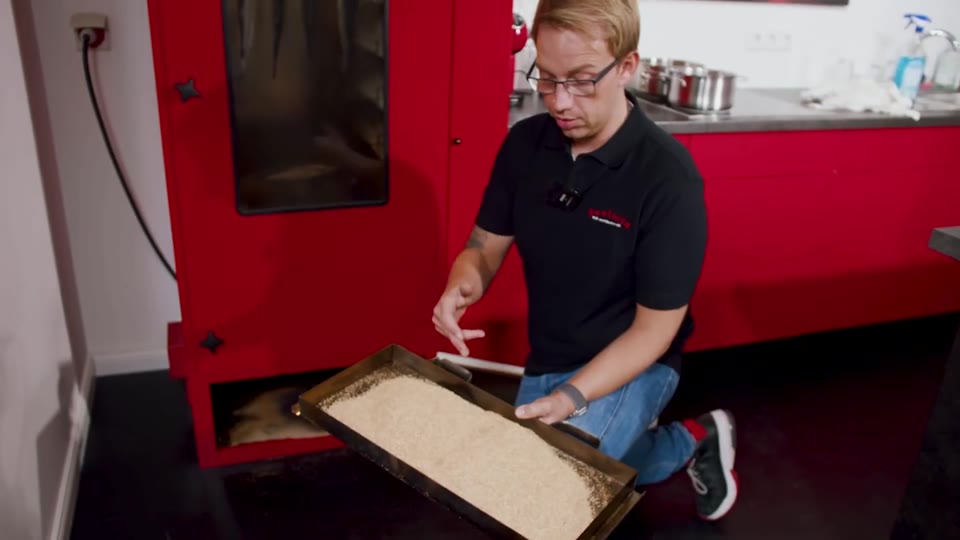
Check the temperature where the fish are hanging – not just high up in the lid. A separate core thermometer is later placed at the thickest point next to the spine, without touching the bone.
Step 6: How do I smoke for 1.5 hours at 85 °C?
Short answer: fill in fine cherry smoking dust, start the ignition in the electric device shown for approx. 15 minutes and cook/smoke the trout at a constant 85 °C for a total of 1.5 hours.
Cherry wood brings a fruity note in the video; fine dust with 500–1000 µm smoulders evenly. Beech of the same fine grain is the classic, mildly spicy alternative. Use dry, bark-free hardwood or fruitwood – no resinous softwood.
The 15 minutes refer to the smoke ignition of the smoker shown. Modern or other controls can switch off automatically or use a different factory value; in the F4/F5 video, for example, 20 minutes are mentioned as a device-specific empirical value. Do not arbitrarily transfer an unfamiliar ignition value.
Thin, blue-grey to almost invisible smoke is correct. Thick white smoke does not mean more aroma, but too little clean combustion and a higher risk of bitter creosote. Keep the exhaust air open and control the temperature via the intended energy/air supply regulation.
Step 7: How do I know that the trout is cooked?
Short answer: the eyes are milky white, the skin peels off cleanly from the fillet and the measured core temperature is approximately 60–65 °C in DACH practice.
Check at the thickest point. The 1.5 hours are only complete if the cooking result is also right. The knowledge base cites 62.8 °C for at least 30 minutes as a conservative FDA process anchor for hot-smoked fish; this official processing value is stricter than many DACH hobby recipes. The crucial thing is: do not judge by colour or time alone.
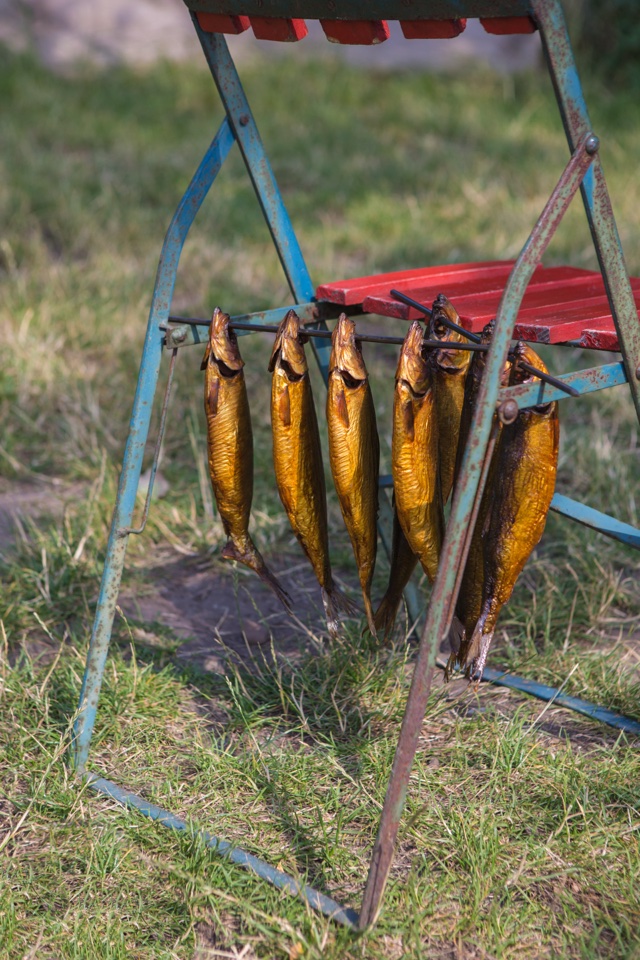
Take the fish out with clean tools, let them cool down protected and then chill them quickly. Freshly hot-smoked trout is not an unchilled long-life product. In the event of a putrid smell, slimy surface after storage or bloated vacuum packaging, do not taste or "save" it, but dispose of it.
Which beginner mistakes can be avoided immediately?
Short answer: a dry surface, measured temperature and clean thin smoke prevent most failed first batches.
| Error pattern | Probable cause | Next attempt |
|---|---|---|
| pale and patchy | surface still moist, contact points | dry longer, more distance |
| bitter or tongue-numbing | thick/trapped smoke, wrong wood | open exhaust air, produce thin smoke, only dry hardwood |
| too salty | brine stronger or time longer than planned | weigh exactly, stick to 8% and 12 h |
| dry/rubbery | too hot, too long, core not measured | stabilise 85 °C, check core temperature |
| fish falls off the hook | only hooked in the meat, too moist, heated too quickly | anchor in the bones, form pellicle |
| black streaks | grease burns or condensate drips | check grease drip tray and air flow |
Who is this beginner's process not suitable for?
No-fit: this guide is not suitable for cold smoking raw fish or meat, not for unknown homemade barrels, not for operation in a garage/shed and not as a substitute for commercial HACCP process validation.
Even if you only smoke two fish once a year, you do not have to buy a large cabinet immediately; a suitable table smoker can be enough. Conversely, a large club or sales batch should not be squeezed into a small smoker. The capacity guide helps with the selection.
What should I learn after the first run?
Short answer: document the fish weight, weather, drying state, cooking chamber and core temperature, smoke appearance and result – and only change one variable next time.
This turns luck into a reproducible process. Start with the same brine and the same temperature sequence. Only when the basic process is solid should you vary the wood type, spices or smoke intensity. Cold smoking cured meat or fish is a later learning stage because, without the cooking effect, it requires significantly stricter knowledge.
Frequently asked questions about smoking for beginners
Which smoking method is best for beginners?
Hot smoking, ideally trout. The product cooks completely, the process takes hours instead of days, and both the cooking chamber and core temperature can be controlled directly.
How do I mix an 8% brine?
80 g of salt per litre of water. In the Beelonia practical video, it is exactly 560 g of salt to 7 l of water for five salmon trout, then covered in the fridge for 12 hours.
Does trout have to dry before smoking?
Yes, until the skin is dry and leathery-sticky. In the video, it is 1–2 hours in the fridge or alternatively approx. 40 °C with circulating air in the smoker.
At what temperature do beginners smoke trout?
This practical process uses a constant 85 °C for a total of 1.5 hours. General technical sources mention broader or two-phase corridors; do not switch between methods on your first attempt and check the core.
How do I recognise a finished smoked trout?
Milky-white eyes and cleanly peeling skin are the video tests. More reliable is the additional measurement at the thickest point: approximately 60–65 °C core temperature in DACH practice.
Ready for your first smoke?
Beelonia GmbH has been manufacturing smoking technology in Beelen since 1880 – and will advise you personally on the model, heating type and accessories.
Sources and data status: Exact practical process, ingredients and device values: official Beelonia video "Smoked trout – easily smoke it yourself", evaluated on 23.07.2026. Device operation and ignition value classification: Beelonia videos F2-70/60 & XL, F4 & F5 as well as Smoky 5 & 6. Technical corridors and safety: Beelonia knowledge base "Cold, warm & hot smoking", "Device & smoker knowledge" and "Error patterns & troubleshooting", including FDA, BfR, Culinary Institute of America, MikesBigTrouts and Räucherwiki. The 85 °C video practice and broader technical corridors are deliberately classified separately.


