



Smoking mistakes: bitter, pale, rubbery – diagnosis

The most common smoking mistakes happen before the food even reaches the smoker – above all, insufficient surface drying. This causes four different defects at once (pale, spotty, sour, falling off the hook). The diagnostic table below matches each symptom with its probable cause and the remedy. One rule stands above all: some symptoms have both a harmless and a dangerous cause – when in doubt, safety comes first, not a rescue trick.
Last updated: 23 July 2026 · Author: Michael Vering, Beelonia GmbH · All prices: as of July 2026
Reading tip: The biggest single lever against mistakes is clean smoke – find out why in Blue smoke, white smoke.
The diagnostic table: Symptom → Cause → Remedy
| Symptom | Probable cause | Remedy |
|---|---|---|
| Bitter, 'numbs' the tongue | Creosote from trapped white smoke | Open exhaust air, use dry hardwood, drip tray; cut off the crust |
| Sour / vinegary | 'Tar vinegar': moist surface + smoke; condensation | Dry better, pre-warm the food, create a draught |
| Too salty | Brine too strong/too long | Soak in water/milk for 10–15 min; use 5–8 % brine in future |
| Bland, not enough smoke | Smoked too short, moist surface, eaten too hot | Smoke longer, dry, let it air out overnight |
| Pale, no colour | Missing pellicle – smoke rolls off | Dry until leathery, smoke at 60–80 °C, smoke again |
| Spotty | Islands of residual moisture, condensation drops | Dry evenly, use crepe/cardboard against condensation |
| Too dark / sooty | Incomplete combustion, softwood, >90–100 °C | Open air supply (blue flame), use beech, lower temperature |
| Too dry / hard | Too hot, too long, lean fish | Measure core temperature (~60–65 °C), cook at 80–90 °C |
| Rubbery | Overcooking – protein denatures, water lost | Core temperature control, increase temperature slowly |
| Fish falls off the hook | Too moist, heated too quickly, wrong hook | Dry until leathery, use round arch hooks around the spine |
| White coating | Salt/tyrosine (crumbly) or mould (furry) | Finger test; foreign mould → dispose of |
| Blown pack / putrid | Gas-forming bacteria, botulism type E (odourless!) | Dispose of – never try to save |
The four error families – and their common denominator
Almost all symptoms belong to four families: smoke errors (bitter, sooty), moisture errors (pale, sour, spotty), temperature errors (dry, rubbery, burst) and hygiene/spoilage cases. The first three are fixable – the fourth is not. The common denominator of the fixable ones: preparation. If you salt correctly (calculate brine), dry consistently until the skin is leathery (pellicle) and work with a thermometer, you eliminate three quarters of all defects before the smoker even produces smoke.
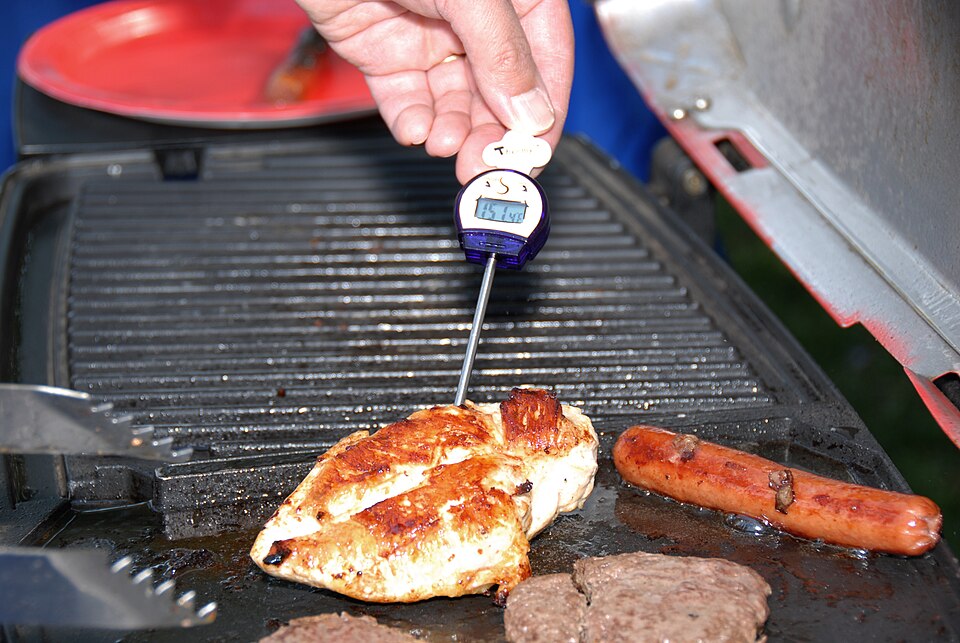
The classic temperature mistake: Above 90–100 °C the fat melts, protein leaks out as a white jelly-like mass (albumin), the fish bursts – and dripping fat in the embers creates additional bitter smoke and the risk of a grease fire. Therefore: cook at 80–90 °C, place a fat tray over the embers, measure the core temperature instead of guessing. The target values for each product can be found in the smoking temperature table.
The safety paragraph – without exception: A blown vacuum pack, putrid smell, greasy coating after maturation or furry foreign mould mean microbial spoilage. With smoked fish, the central danger is botulism type E – odourless and sensorially invisible. Such goods must be disposed of; cooking does not make them safe, and the smell test proves nothing.
Frequently asked questions about troubleshooting
My result tastes disappointing fresh out of the smoker – a mistake?
Not necessarily: smoke aroma needs time to harmonise. Many products taste much more rounded the next day. Let smoked goods air out covered in a cool place overnight before judging.
Where do dark drip spots on the food come from?
From condensation: moist air settles on cold inner walls, mixes with soot and drips. Remedy: keep food and wood dry, pre-warm the food, use a double-walled smoker – details in the article Avoiding condensation.
Can I still eat food that has turned out too dark?
Visually too dark is uncritical – but cut off anything sooty and bitter. Remove the crust and taste the inside; next time, open the air supply and lower the temperature.
Reading tip: For smokers that don't even reach temperature or where the smoke doesn't draw, there are separate diagnoses: Smoker doesn't get hot and Smoke doesn't draw.
Fewer mistakes, more enjoyment
Thermometers, quality smoking dust and smokers with clean air flow – Beelonia GmbH provides the tools against every defect. Since 1880.
Sources and technical basis: Diagnostic systematics from the defect dossier (23 symptoms with causes and remedies; creosote, tar vinegar, pellicle, albumin, dry rim, blown pack/botulism type E); safety guidelines according to official sources (BfR). Prices: beelonia-shop.de, as of July 2026.


