



Smoking temperature chart: fish, meat, sausage, cheese

A reliable smoking temperature table always lists the chamber, core, time and product process together. For classic quality, cold smoking usually takes place at 15–25 °C and does not cook the food. In the DACH region, hot smoking frequently operates at 60–120 °C; whether fish, meat or sausage is ready is determined by the right core-time combination – not a blanket 'safe' number.
The values are professional ranges and documented Beelonia practice. They do not replace an approved recipe or HACCP validation. Piece thickness, fat, curing, starting temperature, load and airflow alter the process. Stricter requirements apply especially to warm smoke, poultry, raw sausage and vacuum-packed smoked fish.
Last updated: 23 July 2026 · Author: Michael Vering, Beelonia GmbH · Reading time: approx. 13 minutes
Which smoking temperatures apply at a glance?
Each row in the table is a process package, not an isolated target value. 'Chamber' refers to the air at the level of the food being smoked, 'core' to the coldest relevant point. If a core value is missing, the product remains raw or the value must come from the specific production plan.
| Product / Process | Preparation | Chamber | Core / End point | Time & Context |
|---|---|---|---|---|
| Trout, hot | brine, rinse, dry | often 80–110 °C; Beelonia 85 °C | DACH frequently 60–65 °C; FDA process reference 62.8 °C for at least 30 min | usually 60–120 min; Beelonia 90 min |
| Stremellachs, hot | 7% brine 12 h, dry for 1–2 h | Beelonia 85 °C | not specified in the video; check product-specifically | 90 min in the video |
| Salmon, cold | professionally cure/salt and dry | Quality 15–25 °C; video upper limit 30 °C | no cooking, remains raw | multiple cycles according to validated recipe |
| Mackerel/eel, hot | salt, dry, note fat content | frequently 60–100 °C, species-specific | Professional practice around 60 °C; stricter processes may require more | measure instead of clocking |
| Raw ham/bacon, cold | cure, rest, dry, mature | 15–25 °C | no cooking, remains a raw product | cycles of 6–12 h; days to weeks |
| Raw sausage, cold | Curing, fermentation and drying | 15–25 °C | pH, aw, salt and maturation plan are decisive | no universal time |
| Scalded sausage, hot | defined recipe | often 60–80 °C, practice 70–75 °C | Core-time specification from recipe/operational process | often 30–60 min smoke plus cooking/scalding |
| Kassler, warm | defined curing and cooking plan | frequently 25–50 °C | Warm smoke alone is not a cooking end point | often 1–4 h; cook afterwards if necessary |
| Poultry, hot | Core probe without bone contact | approx. 90–120 °C | Professional guidelines at least 70–72 °C over a defined holding time | Cut and filling change the duration |
| Large BBQ meat | cook indirectly | US usually 107–135 °C | 88–95 °C for pulled pork is a texture goal, not a blanket safety goal | often 8–18 h |
| Hard cheese, cold | dry and well chilled | frequently below 20 °C; stop before sweating | no cooking | approx. 2–8 h |
What is the difference between chamber and core temperature?
The chamber describes the climate in the smoker, the core describes the condition of the food. A chamber temperature of 85 °C does not mean the core is at 85 °C. Mass, thickness, bones, fat, air speed and starting temperature determine how quickly heat reaches the coldest point.
A door thermometer can deviate from the temperature at the product. Zones form in tall or full cabinets. The chamber probe therefore hangs freely at the level of the food, without metal contact. The core probe is placed in the thickest part: near the spine for fish, in the thermal centre for meat, and without bone or cavity contact for poultry.
Reading tip: How the temperature windows relate to the processes is explained in the Process Guide; beginners should start with the 7-Step Guide.
How is the smoking temperature measured correctly?
Two probes are the practical minimum solution for hot smoking: chamber plus core. For large batches, multiple chamber points and product samples are added. Correct placement, known measurement deviation and a time-temperature log are more important than a particularly nice display curve.
- Check probes with ice water near 0 °C and boiling water near 100 °C; note the altitude.
- Place the chamber probe a few centimetres next to the product, not on the wall or heater.
- Insert the core probe sideways into the thermal centre; avoid bones and fat veins.
- Note the starting temperature, target/actual chamber, core, phase changes and holding time.
- In case of wind, full load or heavily fluctuating readings, fix the cause instead of sugar-coating averages.
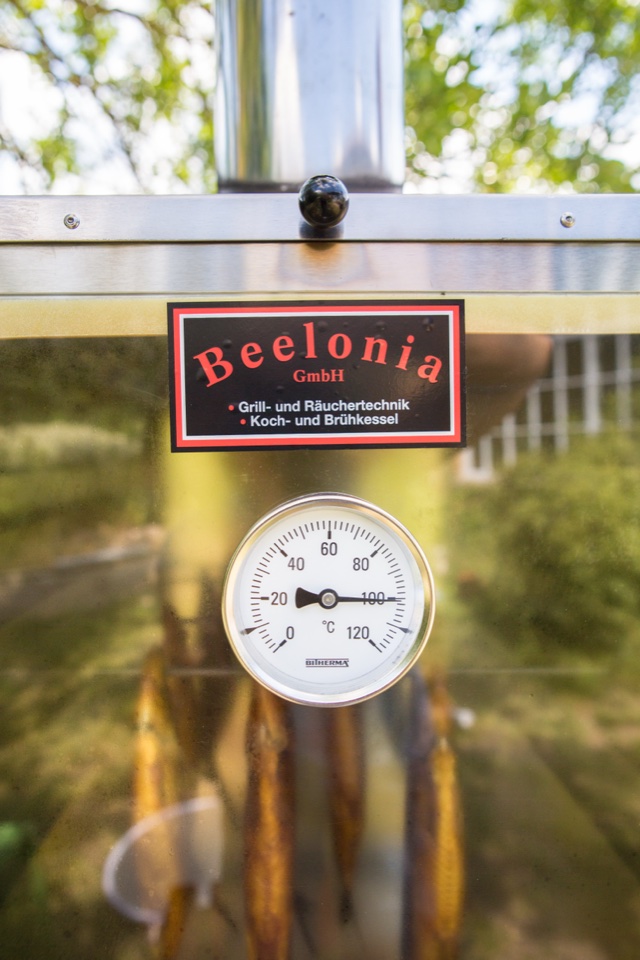
Which temperature works for trout?
85 °C for 1.5 hours is documented Beelonia practice, but not a universal trout curve. In the video, five salmon trouts are placed in an 8% brine for 12 hours: 560 g of salt to 7 litres of water. After rinsing, they dry for 1–2 hours; alternatively at around 40 °C with convection.
| Step | Beelonia video |
|---|---|
| Preheating | 85 °C |
| Smoking dust | fine cherry, 500–1000 µm |
| Ignition | approx. 15 min |
| Cooking/smoking time | 1.5 h at 85 °C |
| Cooking indicators | milky-white eyes, skin peels off; core measurement complements the visual test |
Which temperature works for Stremellachs?
In the Beelonia video, similarly sized strips run for 1.5 hours at a constant 85 °C. Beforehand, they are placed in a 7% brine – 140 g of salt to 2 litres of water – for 12 hours and dry for 1–2 hours. The seasoned beech smoking dust 'Mediterraner Zauber' is ignited for 10–15 minutes.
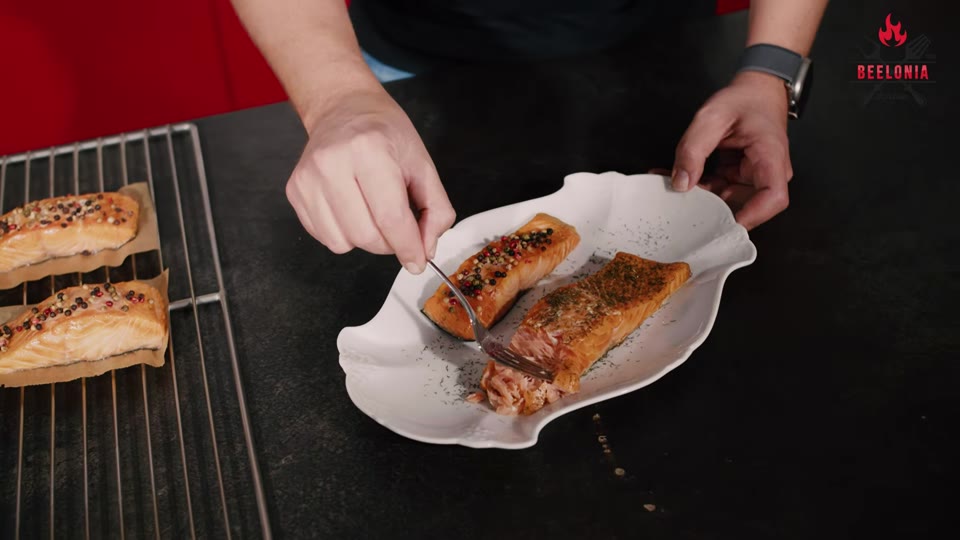
The video does not mention a measured core temperature. Therefore, no safety number is invented from this. If you change the piece thickness, smoker, load or starting temperature, measure the core and use a professionally appropriate core-time specification for hot-smoked fish.
How should the professional program 40/85/60 °C be classified?
The F4/F5 video shows a device program, not a universal recipe: 40 °C for 30 minutes drying with convection, 85 °C for 45 minutes cooking/smoke and 60 °C for 30 minutes gentle smoke. The 105 minutes apply to the device, load and prepared trouts of the described process.
| Step | Setting | Purpose |
|---|---|---|
| 1 | 40 °C / 30 min, convection on | Dry surface |
| 2 | 85 °C / 45 min, smoke on | Heat and smoke |
| 3 | 60 °C / 30 min, no new ignition | Gentle smoke, colour, aroma |
How do 15–25 °C and a maximum of 30 °C fit together for cold smoke?
15–25 °C is the quality range; 30 °C is the technical upper limit mentioned in the Beelonia video. Plan for below 25 °C so that ember heat, sun and sensor deviation leave a reserve. Salmon can excrete protein if the temperature is too high. Cold smoke does not cook; curing, drying, maturation and cooling remain crucial.
The F6-100 case study shows around 160 kg of meat, six days of cold smoke and readings of 14 °C/20 °C. This is a real commercial case, not a recipe for other products or hobby smokers.
Which temperature applies to meat, sausage and cheese?
These categories need different end points. Raw ham and salami remain raw in cold smoke; scalded sausage is treated hot; Kassler can include warm smoke; US BBQ often runs at 107–135 °C. The recipe and final state determine the chamber, core and holding time.
Warm smoke at around 25–50 °C stays in a microbiologically critical range for a long time and is not a starting point without a defined overall process. For poultry, at least 70–72 °C over a set holding time applies according to relevant professional guidelines; whole birds are often kept higher in practice. A filling changes the process.
Cheese is smoked cold and below its sweating or melting point. Below 20 °C is practical for many hard cheeses; sensitive varieties need less. Start with 2–4 hours, stop at the latest when fat escapes or the surface softens, and then let it rest in a cool place.
Which safety limits must the table not conceal?
A chamber temperature alone is never proof of safety. Warm smoke keeps goods in approx. 4–60 °C for a long time, cold smoke does not cook, hot smoke must reach the necessary core over the necessary time. Smoke colour and aroma prove neither germ reduction nor shelf life.
- Fish: DACH practice frequently cites around 60 °C core; the FDA reference requires 62.8 °C for at least 30 minutes for hot-smoked fish. These are different regulatory frameworks.
- Poultry: Core-time specifications are mandatory; place the probe without bone contact.
- Cold-smoked fish: remains raw and requires control of salt, cooling, packaging and shelf life.
- Shelf life: freshly hot-smoked goods must be kept refrigerated. Smoke alone does not make them stable at room temperature.
- Risk groups: observe official recommendations on smoked fish.
When should you not use the table?
Without product thickness, recipe, curing status, device configuration and measurement, a range becomes a guessing game. Vacuum-packed goods, commercial production, poultry and fermented raw sausage in particular need validated specifications.
| No-Fit | Why the table is not enough |
|---|---|
| interrupted cold chain | initial state unclear |
| improvised curing | salt/nitrite effect not proven |
| very different piece sizes | core development drifts apart |
| long vacuum storage | own botulism/listeria control necessary |
| stuffed poultry | thermal centre changed |
| commercial batch | HACCP and documentation required |
Which devices help with stable temperatures?
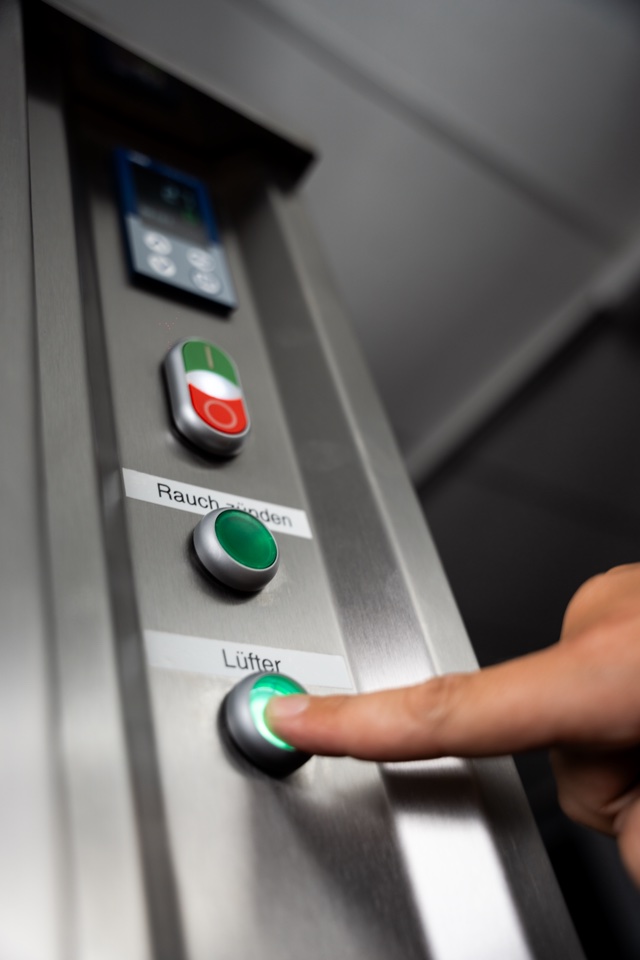
Measuring comes before regulating, regulating before automating. Thermometers show the actual state, thermostats maintain the heat source, program controls map out phases. Double-walled smokers reduce the influence of weather and condensation, but do not replace core control.
| Task | Beelonia solution | Price 07/2026 |
|---|---|---|
| Measuring | Thermometer | from €38.08 |
| Regulating F1/F2 | Thermostat | from €249.90 |
| Automating phases | PC control | from €1,938.51 |
| Small batch | Smoky 4 | from €540.26 |
| Ambitious | F2 | from €1,401.82 |
| Club/farm shop | F2-70/60 XL | from €2,698.92 |
| Professional | F4 | from €7,457.73 |
For cold smoke, there is the smoke generator from €497.42 as well as the smoke generator F4–F6-100 from €1,001.98 (as of 07/2026). External generation separates smoke and cooking heat.
Which questions are asked most frequently?
Which temperature is the right one for smoking?
There is no single right temperature. Cold smoke is usually at 15–25 °C and does not cook, warm smoke frequently at 25–50 °C, hot smoke in DACH practice usually at 60–120 °C. The product additionally determines the core, holding time and pre-treatment.
Is the temperature display on the smoker enough?
No. It only shows the air at its installation location. For hot smoke, you additionally need a core probe in the thickest part. For large cabinets or full loads, multiple chamber points make sense.
Can you always smoke trout at 85 °C for 1.5 hours?
No. This is documented Beelonia practice for prepared salmon trouts in the electric smoker shown. Fish size, starting temperature, load and device alter the process. Check cooking indicators and core instead of blindly following the clock.
Are 30 °C still allowed for cold smoking?
The Beelonia video describes 30 °C as the technical upper limit. The preferred quality range is 15–25 °C. Plan for below 25 °C and keep a reserve. Even 30 °C does not produce a reliable cooking effect.
At what temperature is cheese smoked?
Cheese is smoked cold and below its sweating or melting point. Below 20 °C is practical for many hard cheeses; sensitive varieties need less. Start with 2–4 hours, observe the surface and let it rest in a cool place.
How do you use the table in practice?
Choose the product and process, then the complete range including preparation, core target and time logic. Place the chamber and core probes correctly, document the process and change only one variable per test. This way, the table becomes the starting point for a reproducible process – not a substitute for measuring.
Temperature under control
Beelonia GmbH has been manufacturing smoking technology in Beelen since 1880 – and will advise you personally on the model, heating type and accessories.
Sources and professional basis: German Food Code Commission (Deutsche Lebensmittelbuch-Kommission), Guidelines for Fish and Fishery Products; FDA, Processing Parameters Needed to Control Pathogens in Cold-Smoked Fish; BfR/BVL on listeria; USDA-FSIS on the 'Danger Zone'; Austrian Food Code and professional authorities on poultry; Culinary Institute of America; DACH professional practice; Beelonia videos 'Smoked trout', 'Hot smoking salmon', 'The smoke generator', 'Presentation of professional smokers F4 & F5' and F6-100 case study. Numerical conflicts are identified as quality ranges, technical limits or different regulatory frameworks.


