



Beelonia Smoky or F-series? The series comparison

When comparing the Beelonia Smoky vs. the F-Series, there is no universal winner: Smoky is the sensible, single-walled entry-level choice for batches of up to around 25 fish. The double-walled F-Series costs more, but keeps the temperature more stable in wind and cold, and can handle up to 120–130 fish. If you only smoke occasionally in the summer, you don't automatically need the F-Series; if you work frequently or with large batches, you should consider the extra cost.
Both series are stainless steel smoking cabinets and can generally be heated with wood, gas or electricity. The main difference therefore doesn't lie in the available fuel, but in the casing construction, size grading and process reserve. We are comparing exactly these points using the current product data from 23 July 2026.
Last updated: 23 July 2026 · Author: Michael Vering, Beelonia GmbH · Gross prices 'from', as of 07/2026
How do the Smoky and F-Series differ at a glance?
Smoky prioritises a lower purchase price and compact hobby batches; the F-Series prioritises insulation, weather stability and growth. The Smoky models offer three levels and hold around 10 to 25 fish. The F-Series also starts with three levels in the compact F1, but expands to five from the F2 upwards, and to seven levels in the XL model.
| Criterion | Smoky | F-Series |
|---|---|---|
| Wall construction | Cabinet single-walled; door double-walled and insulated according to video | Cabinet double-walled and insulated |
| Capacity range | approx. 10–25 fish | 15–20 to 120–130 fish |
| Levels | 3 | 3, 5 or 7 |
| Heating types | Wood, gas, electric interchangeable | Wood, gas, electric interchangeable |
| Weather reserve | More strongly influenced by wind and outside temperature | More stable due to double wall, but not weather-independent |
| Price range | from €540.26 to €706.86 | from €1,035.30 to €2,698.92 |
| Typical fit | Beginners, families, anglers | Frequent hobby, club, farm shop, commercial |
What does single-walled or double-walled mean in practice?
A double wall slows down the heat exchange with the surroundings and makes the cooking chamber less volatile. With a single-walled Smoky, cold wind, winter temperatures and direct sun affect the inner wall more quickly. This is manageable, but requires more observation, preheating and potentially more heating power than with the insulated F-Series construction.
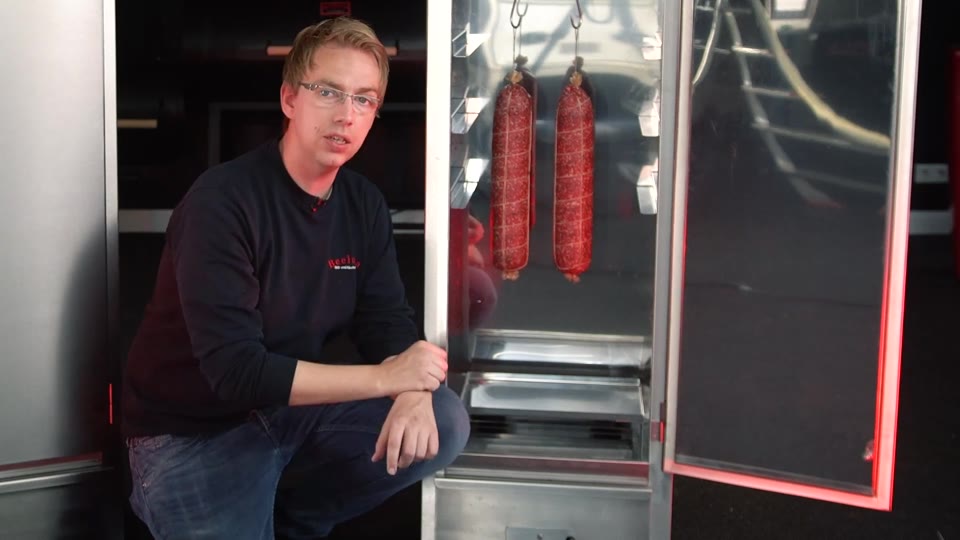
In the video for the F2 and F2-70, Michael Vering shows a construction of inner and outer sheet metal with insulation in between. The resulting advantages – lower energy requirement, more stable temperature and less condensation – are technically plausible and are also supported by manufacturer-neutral equipment sources. However, the video itself does not provide a parallel consumption measurement against the Smoky. We therefore treat these statements as a construction effect, not as a guaranteed percentage saving.
The Smoky series is not completely 'uninsulated' in the colloquial sense: in the Smoky video, the door is shown separately as double-walled and insulated. However, according to current series data, the cabinet body remains single-walled. This nuance explains why the door is not the decisive difference compared to the fully double-walled F-Series casing.
Reading tip: The comprehensive smoker buying guide compares all eight models of both series; the heating types comparison shows which heating drawer suits you best.
Which Smoky size suits which batch?
Smoky 4 covers the small family batch, Smoky 5 manages a larger quantity, Smoky 6 adds volume and hanging height. All three have three levels and a base area of 380 × 500 mm according to current product data. The height increases from 800 to 1,000 to 1,250 mm.
| Model | Capacity | Dimensions | Price from |
|---|---|---|---|
| Smoky 4 | approx. 10 fish / 3 levels | 380 × 500 × 800 mm | €540.26 |
| Smoky 5 | approx. 18 fish / 3 levels | 380 × 500 × 1,000 mm | €630.70 |
| Smoky 6 | approx. 25 fish / 3 levels | 380 × 500 × 1,250 mm | €706.86 |
The decision between Smoky 5 and 6 shouldn't just be based on the number of fish. If you want to smoke eels, longer cuts of meat or sausages hanging up, you will benefit from the additional height of the Smoky 6. If you predominantly process fillets on three grates, you need to consider whether the taller chamber actually offers any benefit.
Which F-Series size follows on from the Smoky?
F1 is the compact switch to the double wall, F2 is the typical leap into the next capacity class. The F1 holds 15–20 fish and therefore deliberately overlaps with the Smoky 5. The extra cost here doesn't primarily buy you a higher quantity, but the insulated construction.
| Model | Capacity | Levels | Price from |
|---|---|---|---|
| F1 | 15–20 fish or 8–10 kg | 3 | €1,035.30 |
| F2 | 30–35 fish or 20–25 kg | 5 | €1,401.82 |
| F2-70 | 45–60 fish or 30–40 kg | 5 | €1,799.28 |
| F2-70/60 | 65–80 fish or 50–65 kg | 5 | €2,262.19 |
| F2-70/60 XL | 120–130 fish or 80–100 kg | 7 | €2,698.92 |
The weight specification is often more helpful for meat, sausage and different sized fish than a quantity. With 30 large salmon, different spacing applies than with portion-sized trout. Every capacity assumes that smoke and heat can circulate; the theoretical number of hooks is not a quality target.
Is the F1 better than a Smoky 5 or 6?
The F1 is not generally better, but has different construction priorities. With 15–20 fish, it sits between the Smoky 5 and 6, but costs significantly more at €1,035.30 and up. The extra cost is worth it if double-walled construction and frequent use are more important to you than maximum capacity per euro.
For ten summer sessions a year, a Smoky 6 with around 25 fish can be the more economical choice despite its larger capacity. If, on the other hand, you work weekly, smoke at low outside temperatures or want to keep temperature fluctuations as small as possible, you should seriously compare the F1 despite its lower nominal quantity. Flavour is not automatically created by the more expensive wall; the benefit lies in the process control.
What is the difference between the interiors of the two series?
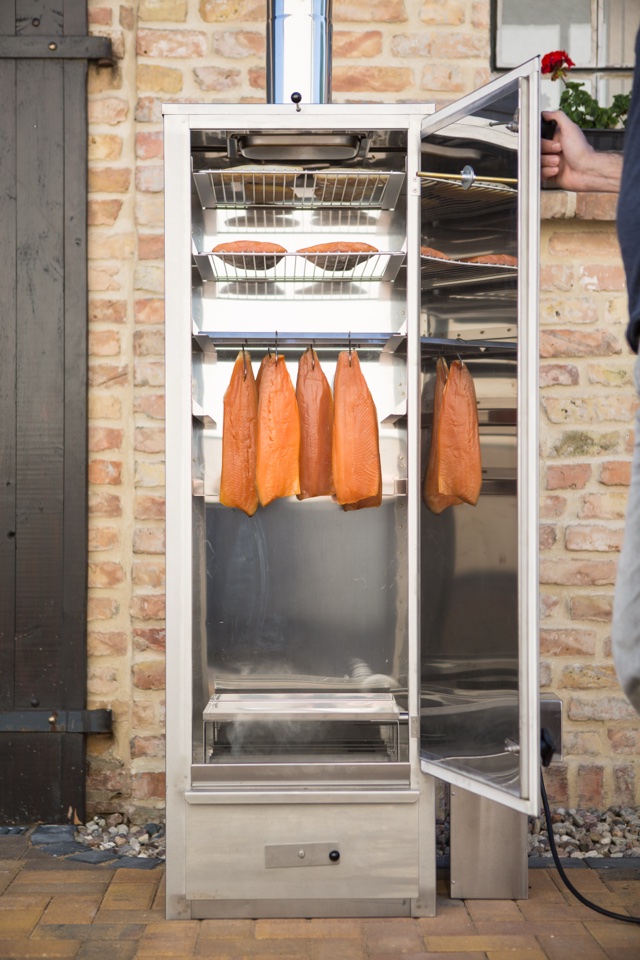
Both series accommodate grates, rods and hooks; from the F2 upwards, the F-Series adds more levels and a firmly welded slatted intermediate shelf. According to the product demonstration, this shelf distributes heat and smoke, and also prevents fat from dripping directly into the heating or ember area.
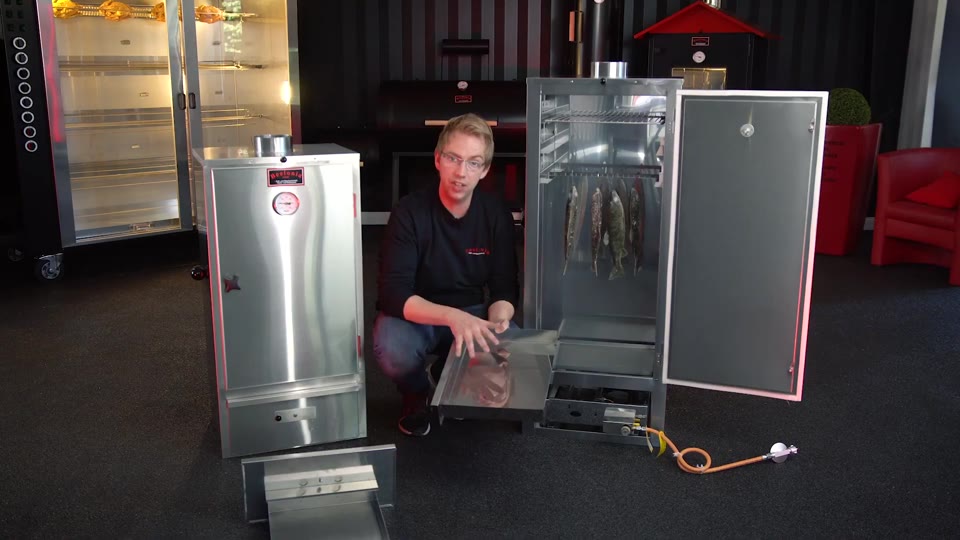
For the Smoky, the video shows three support levels, a fat drip tray and the 130 mm exhaust with an adjustable slider. Flat grates are suitable for fillets, for example, wavy grates for lying fish, and rods and matching hooks for hanging goods. The F-Series demonstration shows five slots on the F2 as well as the slats below the food being smoked. For everyday use, this means: the F2 can stack more flat goods, while the Smoky deliberately remains simpler with three levels.
Do the Smoky and F-Series have different heating types?
No: both series can generally work with wood, gas or electricity. The heating is located in an interchangeable lower drawer or module. The difference lies in the respective matching components and controls, not in an exclusive heating type. A Smoky heating block therefore does not belong in an F2.
The Smoky video shows a standard wood drawer as well as an optional 4 kW gas and a 2.5 kW electric drawer. The F2/F2-70 video demonstrates the switch to an 8 kW gas drawer. These power specifications refer to the systems shown and are not general advice to always choose the highest power. A heat source that is too large can be more difficult to fine-tune for low summer target values.
| Working style | Heating type | Most important consideration |
|---|---|---|
| Active and traditional | Wood | Lots of influence, but more attention and learning curve |
| Fast and without a socket | Gas | Mobile, but sensitive to wind and fine adjustment |
| Reproducible and convenient | Electric | Precise with suitable control, but dependent on electricity |
Which series is better suited for cold smoking?
Both can be used for cold smoking; the double-walled F-Series casing offers the greater thermal reserve in cold weather. In the video, the Smoky works with a cold smoke generator in the wood drawer. Regardless of the series, the decisive factors are a cool smoke source, sufficient oxygen, a suitable outside temperature and a cooking chamber below the chosen cold smoke limit.
The frequently mentioned limit is 15–25 °C; some practical sources tolerate up to 30 °C. For conservative planning, under 25 °C applies. Insulation does not prevent all condensation: humidity, moist goods, draughts and temperature differences remain effective. The statement from the F-Series video that no condensation is created due to the insulation should be understood as a manufacturer's practical description, not as a guarantee for every weather condition.
What do the videos show in a direct comparison?
The two demonstrations make the constructional differences visible: three levels and interchangeable drawers on the Smoky, five slots, double wall and slatted shelf on the F2. They are particularly reliable for operating procedures and components. Current prices and capacities, on the other hand, come from the product database from July 2026.
How does the Smoky 5 compare to the Smoky 6?
The Smoky video shows two cabinets of the same width and depth with heights of 1.00 and 1.25 metres respectively. Michael Vering demonstrates the heating change, grates, hooks, fat drip tray and cold smoke generator. The current capacity classifies these sizes at around 18 and 25 fish.
How is the F-Series constructed?
In the F2/F2-70 video, you can see the insulated double-wall construction, five slots and the firmly welded slatted intermediate shelf. In addition, the gas drawer is inserted without tools. Broad capacity specifications from the video do not replace the current model-specific values in the table of this article. Equipment details can change between product generations.
When do I need the F2-70/60 or the XL version?
Depth and XL height are only worthwhile if 65 fish and upwards, 50 kg of goods or long hanging products are regularly on the agenda. For an occasional big day, an oversized cabinet is rarely economical. Clubs and businesses should also plan for loading weight, grate handling, door space and energy supply.
The F2-70/60 is specified for 65–80 fish or 50–65 kg and five levels, starting at €2,262.19. The F2-70/60 XL expands to seven levels, 120–130 fish or 80–100 kg and costs from €2,698.92. Prices as of 07/2026.
When is neither the Smoky nor the F-Series suitable?
For two trout a year, even the Smoky is often more equipment than necessary; for automatic pellet BBQ or industrial throughput, the F-Series considered here is not automatically the right category. A table smoker, an existing grill, a pellet smoker or a dedicated commercial system might better suit the actual process.
The installation location can also be a mismatch: no cabinet should be operated without a safe, non-combustible space, sufficient clearances and a regulated smoke exhaust. Closed garages and sheds are not an alternative solution. For chimney connections or commercial use, local fire, building and hygiene regulations must be clarified.
How do I decide in five steps?
Don't decide backwards from the most expensive model, but forwards from the bottleneck. First the largest regular batch, then weather and frequency, followed by series construction, size and heating. This way, you only pay for the double wall or additional capacity if it actually makes a difference in your own workflow.
- Note down the largest regular number of fish and kilograms.
- Determine the longest item to be smoked and the required grate areas.
- Summer/occasional = consider Smoky; year-round/frequent = also consider F-Series.
- Select the smallest model with some spare capacity.
- Choose wood, gas or electric according to your operating preference and infrastructure.
What are the frequently asked questions about the Smoky and F-Series?
The most frequent questions concern the wall construction, suitability for beginners, cold smoke, the price difference and the most sensible middle ground. The answers briefly classify these points; the model-specific capacities and prices can be found in the tables. Special equipment and changed product generations should be checked separately before ordering.
What is the most important difference between the Smoky and F-Series?
The Smoky smoking cabinet is single-walled and designed as an affordable entry-level model; the F-Series is double-walled and insulated. As a result, the F-Series reacts less strongly to wind and cold in everyday use. In addition, the F-Series starts with a similar small quantity, but extends to significantly larger batches and more levels.
Is the F-Series better for beginners than the Smoky?
Not automatically. The Smoky has an easy-to-understand construction and is more accessible in terms of price. The F-Series makes temperature control easier in difficult weather thanks to its insulated casing, but costs more. For occasional summer smoking, the Smoky is often more sensible; for frequent year-round operation, the F-Series can make getting started more comfortable.
Can the Smoky series also be used for cold smoking?
Yes, with a suitable cold smoke generator and correctly regulated air supply. The Smoky video shows the burning spiral in the wood drawer. However, cold smoking remains highly dependent on outside temperature, humidity and draughts; the single-walled casing buffers cold or changeable weather less than the F-Series. Temperature measurement therefore remains mandatory.
Why does the F-Series cost significantly more?
The extra cost primarily pays for the double-walled, insulated construction, the more complex interior design and, in the case of larger models, more space and levels. This is not an automatic flavour premium. The benefit is evident in process stability, capacity and frequent operation – only then does it pay off in practice.
Which model is the most sensible middle ground?
For up to 25 fish, the Smoky 6 is the largest affordable entry-level model. If you regularly process around 30–35 fish or 20–25 kg and want double-walled construction, you will find the typical middle ground in the F2. For smaller winter batches, the more compact F1 might be a more economically suitable choice instead.
Smoky or F-Series – compare them live?
Beelonia GmbH has been manufacturing smoking technology in Beelen since 1880 – and will advise you personally on the model, heating type and accessories.
Sources: Beelonia product database with gross prices and capacities, as of 23.07.2026; Beelonia videos 'Vorstellung Beelonia Räucherofen Smoky 5 & 6' and 'Vorstellung Beelonia Räucherofen FII + FII70'; supplementary equipment and material research at feinkosten.de, raeucherprofi.net, Räucherwiki and AmazingRibs, among others. Video statements without a series of measurements are classified as manufacturer's practical specifications; old video prices were not used.


