



Which smoker size do I need? Capacity guide

Choose your smoker size based on the largest batch you regularly process, allowing for space between the pieces, rather than the theoretical maximum capacity. Plan for a practical reserve of about 20% free capacity; for large, mixed, or horizontally smoked products, you should allow for even more.
For about eight trout, the Smoky 4 is a good fit, holding approx. ten fish. If you regularly smoke 16 trout, you shouldn't automatically fill the Smoky 5 (which holds approx. 18) to the brim, but rather consider the Smoky 6 or – if you want double-walled insulation – the F1/F2. From 30–35 fish upwards, the F2 introduces a different batch class; commercial models go up to approx. 400–420 fish with the F6-100.
All capacities are approximate values, as of 07/2026. The size and shape of the food being smoked, hooks, levels, hanging or horizontal placement, and the necessary spacing determine the usable quantity.
Last updated: 23 July 2026 · Author: Michael Vering, Beelonia GmbH · Reading time: approx. 11 minutes
How do I determine the right smoker size?
Short answer: Don't note down your annual requirement, but the largest quantity that needs to be ready in a single batch at least several times a season – in both pieces and kilograms.
- How large is your normal batch? Your most frequent run determines the base size.
- How large is your regular peak batch? A family party, weekly market, or club evening counts if it's a recurring event.
- What are you smoking? Ten portion-sized trout require different space than ten large salmon trout, eels, hams, or grates of fillets.
- Does everything need to be ready at the same time? Two batches are often fine for private use, but in sales or catering, they can disrupt your workflow.
- How much reserve does the airflow need? The food being smoked must not touch and shouldn't block the walls, fat drip tray, or heat source.
Which planning formula prevents choosing a size that's too small?
Short answer: Divide the largest regular batch you want (in pieces or kilograms) by 0.8. This gives you a target value with around a 20% practical reserve.
regular peak batch ÷ 0.8 = nominal target capacity
Examples: 16 fish ÷ 0.8 = 20 fish target capacity; 24 fish ÷ 0.8 = 30; 40 fish ÷ 0.8 = 50. The 20% reserve is a planning aid in this guide, not an additional manufacturer capacity. Very large fish, wide 5-prong hooks, mixed products, or horizontal grates may require more space.
| Your situation | Right response |
|---|---|
| Mostly small batches, rarely twice as much | Consider a smaller smoker plus a rare second batch |
| Peak batches occur regularly | Design for the peak batch with a reserve |
| Number of pieces fluctuates, weight remains similar | Give more weight to the kilogram value |
| Many large or long fish | Check hanging height, hook width, and spacing |
| Sales at a fixed time | Avoid an additional batch, prioritise throughput |
How many fish and kilograms fit into which model?
Short answer: The current range goes from approx. ten fish in the Smoky 4 to approx. 400–420 fish or 260 kg in the F6-100.
| Model | Approx. fish | Approx. kilograms | Levels/mounts quantified in the mandatory sources | Price as of 07/2026 |
|---|---|---|---|---|
| Smoky 4 | 10 | not quantified | 3 levels | €540.26 |
| Smoky 5 | 18 | not quantified | 3 support levels | €630.70 |
| Smoky 6 | 25 | not quantified | 3 support levels | €706.86 |
| F1 | 15–20 | 8–10 kg | not quantified | €1,035.30 |
| F2 | 30–35 | 20–25 kg | 5 slots/mounts | €1,401.82 |
| F2-70 | 45–60 | 30–40 kg | not quantified | €1,799.28 |
| F2-70/60 | 65–80 | 50–65 kg | not quantified | €2,262.19 |
| F2-70/60 XL | 120–130 | 80–100 kg | not quantified | €2,698.92 |
| F4 | 220 | 160 kg | not quantified | €7,457.73 |
| F5 | 260–280 | 180–190 kg | not quantified | €7,819.49 |
| F6 | 320–340 | 230 kg | not quantified | €8,809.57 |
| F6-100 | 400–420 | 260 kg | not quantified | €16,707.60 |
'Not quantified' means: No reliable number of levels was available in the provided current product data or the evaluated mandatory videos. It was therefore not derived from model names or neighbouring sizes. For the KR6 from €21,252.21 and KR6-100 from €23,924.95, the capacity is also not added without a specific system design.
Reading tip: The difference between the series is explained in the Smoky or F comparison; for commercial batches from 160 kg, the system planning for butcheries will help; all prices are bundled in the price guide.
Why isn't the maximum capacity my planned capacity?
Short answer: Because capacity values are a guide for suitable goods, whereas real smoke quality requires a clear path for heat and smoke.
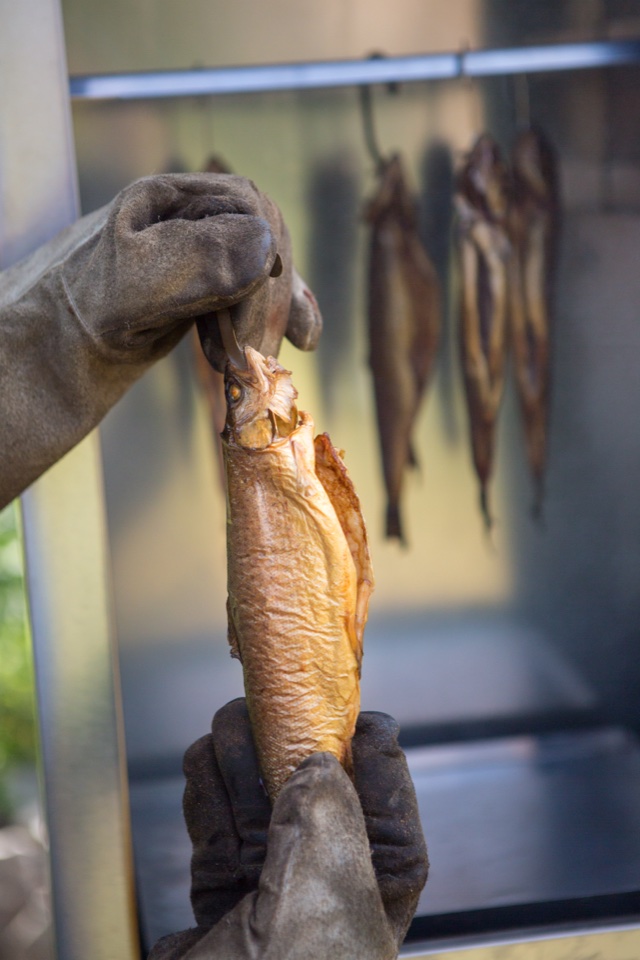
If fish touch each other, light contact patches remain. Hooks that are too close together hinder the airflow; fish of unequal sizes cook at different speeds. Horizontal fillets take up grate space without using the full hanging height. Long eels need height, even if their quantity is small.
The more sensible size is therefore not the smallest chamber you can somehow squeeze everything into. It's the smallest chamber where your typical peak batch can be neatly arranged, controlled, and removed.
When does the number of fish count – and when do kilograms?
Short answer: Always use both values: the number of pieces describes the hook and contact requirements, while kilograms describe the total load of the batch.
With uniform portion-sized trout, the number of pieces is clear. With salmon trout, eel, ham, sausages, or mixed batches, it quickly becomes misleading. An F1 is specified for 15–20 fish and 8–10 kg, an F2 for 30–35 fish and 20–25 kg. These dual specifications show why 'How many fish?' alone isn't a complete question about size.
How do hooks and grates change the capacity?
Short answer: Hanging goods use the height; horizontal goods use levels. Wider hooks and larger fish reduce the number of pieces per rod.
For portion-sized trout, double fish hooks are suitable. The Smoky video recommends the wider 5-prong hooks for fish from around 500–600 g. These secure heavy fish better but require more lateral space. Fillets and hot-smoked salmon sit on flat or corrugated grates; this makes usable slots more important than just the cabinet height.
Which Smoky size is right for me?
Short answer: The Smoky 4 is suitable for small batches of up to about eight fish with a reserve, the Smoky 5 for requirements well under 18, and the Smoky 6 for requirements well under 25 or for longer food to be smoked.
According to the product video, the Smoky 5 and 6 have the same footprint of 50 × 40 cm. The Smoky 5 is 1.00 m high, the Smoky 6 is 1.25 m high. If you have limited floor space, the Smoky 6 gives you extra capacity and hanging height upwards. Both have three support levels and can be fitted with rods or grates.
For a regular 16 fish, the Smoky 5 is nominally close with 18, but leaves hardly any planned reserve. The Smoky 6 is then the more relaxed Smoky choice. If you also want a fully double-walled insulated cooking chamber, you should compare the F1 and F2 alongside it – the number of pieces alone doesn't decide this overlap.
Which F-series fits my batch?
Short answer: The F1 and F2 cover ambitious small to medium batches; the F2-70, F2-70/60, and XL increase the width, depth, and finally the height.
The official F2 video lists the following external dimensions:
| Model | Width × Depth × Height | Current approx. capacity |
|---|---|---|
| F1 | 50 × 40 × 100 cm | 15–20 fish / 8–10 kg |
| F2 | 50 × 40 × 150 cm | 30–35 fish / 20–25 kg |
| F2-70 | 70 × 40 × 150 cm | 45–60 fish / 30–40 kg |
| F2-70/60 | 70 × 60 × 150 cm | 65–80 fish / 50–65 kg |
| F2-70/60 XL | 70 × 60 × 180 cm | 120–130 fish / 80–100 kg |
This grading makes the choice concrete: more height helps with long food and additional mounts, more width creates hook spacing, more depth increases the grate and batch area. The F-series is also double-walled with rock wool; this supports a more stable temperature in changing weather and reduces the risk of condensation.
When is the F2-70/60 XL the right size?
Short answer: When you regularly plan for significantly more than around 80 kg or a three-digit number of fish, or if you need a height of 1.80 m for long goods and batch arrangement.
The XL isn't automatically better than the F2-70/60. It's worth it if its additional interior space is used. The update video shows both variants side by side and explains the automatic temperature control, drying function, and smoke ignition for the electric version. The operating values mentioned in the video are not a capacity guarantee; the current approximate figures remain decisive for choosing the size.
When do I need the F4, F5, or F6?
Short answer: As soon as the focus is not just on volume, but on a repeatable commercial batch flow of approx. 160 to 260 kg.
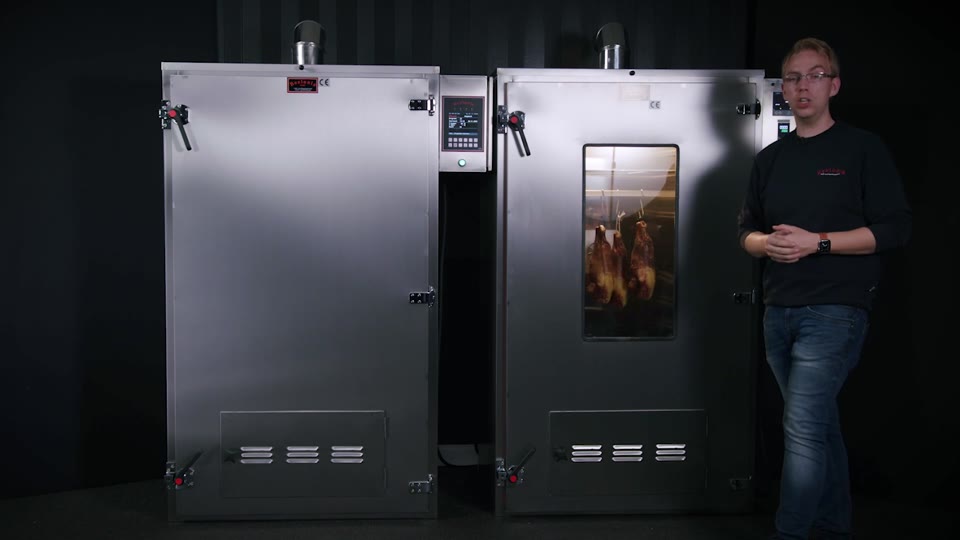
The F4 starts at approx. 220 fish/160 kg, the F5 at 260–280/180–190 kg, the F6 at 320–340/230 kg, and the F6-100 at 400–420/260 kg. The F4/F5 video shows the operational difference: an optional smoking trolley with a ramp, a second trolley that can be prepped in advance, strong latches, and programmable workflows. If you're considering these sizes just for a rare annual event, you should weigh it up against running additional batches or outsourcing production.
Who isn't a large smoker suitable for?
No-fit: A large model isn't suitable if the extra capacity is almost never used, you lack the floor space, or small batches are more important than throughput. Conversely, a small smoker isn't suitable if a regular second batch jeopardises fixed delivery times.
Even a nominally suitable smoker is a no-fit if your food doesn't match the geometry: long eels in a chamber that's too low, wide fillet grates in a chamber that's too narrow, or heavy fish on hooks that are too small. Therefore, alongside pieces and kilograms, always measure your longest and widest typical product.
Which size should I ultimately order?
Short answer: Compare the smallest mathematically suitable size with the next size up, and decide based on reserve, insulation, geometry, batch time, and floor space.
- Largest regular batch recorded in pieces and kg
- Around 20% planned reserve allowed for (more for mixed goods)
- Fish touch neither each other nor the walls
- Longest food fits with clearance from the heat source
- Hooks, rods, and grate layout sketched out
- Second batch consciously accepted or consciously avoided
- External dimensions, exhaust, and safe installation checked
- Desired heating method and weather operation considered
If you answer these points, you'll usually land between two neighbouring models. The rule then is: don't just buy 'as big as possible', but only choose the smaller variant if it can handle the real batch without cramming.
Frequently asked questions about smoker sizes
What smoker size do I need for ten trout?
The Smoky 4 is specified for approx. ten fish. If all ten are regularly smoked at the same time, if there are large fish among them, or if you want plenty of spacing, the Smoky 5 offers more reserve.
How many fish fit into a Smoky 5 or Smoky 6?
The Smoky 5 holds approx. 18 fish, the Smoky 6 approx. 25. Both have a 50 × 40 cm footprint and three support levels; the Smoky 6 is taller at 1.25 m compared to the Smoky 5 at 1.00 m.
Is the F1 big enough for 20 fish?
20 fish is the upper approximate limit for the F1. If you regularly have 20 large fish, you'll lack a reserve; in that case, you should look at the F2 with approx. 30–35 fish/20–25 kg.
Should I choose based on the number of fish or kilograms?
Based on both. The number of pieces determines hook spacing and contact areas, while kilograms better represent fish of varying weights and other products. In addition, the length, width, and horizontal grate area must be suitable.
How much space reserve makes sense?
This guide recommends around 20% as a starting point. For large, uneven, or horizontally smoked products, more makes sense; however, a reserve doesn't replace checking the actual hook and grate arrangement.
Found your size?
Beelonia GmbH has been manufacturing smoking equipment in Beelen since 1880 – and will advise you personally on models, heating methods, and accessories.
Sources and data status: Current prices, handles, and approx. capacities: Beelonia product data, as of 23.07.2026; capacities depend on size and spacing. Dimensions, mounts, and construction details: official Beelonia videos Smoky 5 & 6, F2 & F2-70, F2-70/60 & XL, and F4 & F5. Technical classification regarding height, spacing, insulation, and sizing: Beelonia knowledge base 'Appliance & Oven Knowledge', triangulated with feinkosten.de, raeucherprofi.net, and the Räucherwiki buying guide, among others. Older capacity or price mentions from videos were not used to override the current data status.


